"Self-sufficiency does not mean 'going back' to the acceptance of a lower standard of living. On the contrary, it is the striving for a higher standard of living, for food that is organically grown and good, for the good life in pleasant surroundings... and for the satisfaction that comes from doing difficult and intricate jobs well and successfully." John Seymour ~ Self Sufficiency 2003
Showing posts with label fruit trees. Show all posts

Saturday, 18 December 2021

Re-usable jam tins

The mousebirds have decimated the fruit on my trees this year, so this week I had to pop into the supermarket to buy a tin of jam.

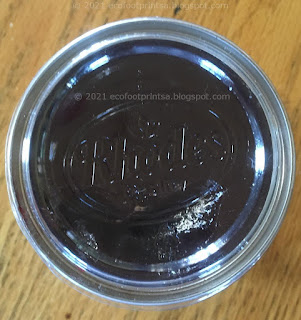
Looking at all the jars and tis of jam, I spied this...

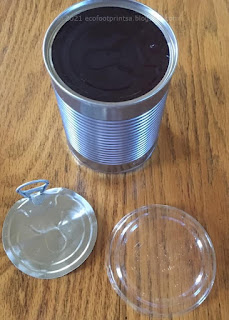
Tin with ring pull, and re-sealable, re-usable lid


A tin of Rhodes jam with a re-usable lid.

Wonderful!

Yes, the lid is plastic, but it is really well fitting and will allow for the tin to be re-used for a myriad of times - until the lid deteriorates. 

Button, screws, beans, seeds...  And if one had to pierce that lid with tiny holes, the it could even be used for sprouting seeds.

Well done, Rhodes.  You thought outside the box.


Saturday, 2 December 2017

Harvesting and rooting

Youngberries at various stages of ripeness
I have started to harvest youngberries - and have discovered that I have competition.

Not the normal competiton - not the normal mousebirds, mice nor snails, but the four-legged kind of competition.  Actually, (without jinxing it) in contradiction with last year, I haven't seen a single mousebird this year...?
Stellar searching for ripe youngberries at ground level
It turns out that Stellar has a penchant for youngberries, and, braving the countless prickles / tiny thorns to her nose (I can't see how she can avoid them) she helps herself to ripe youngberries down at floor level.   She even takes them straight from my hand 😆

I never knew dogs ate berries...

Just a bowl of unimaginable yumminess 😆
Tonight we are having a fruit salad with freshly picked plums and youngberries and I have already harvested enough berries already to make 3 bottles of youngberry cordial and 4 large jars of jam - and I have at least 7 more harvests to gather in...

Help!!

I reckon I'll be giving away a lot of fresh youngberries this year... 😀

Then, the other day I wanted to make mashed potatoes and when I went to get some from my pantry I saw that they had all started sprouting.
My potatoes had started sprouting from the eyes
I was faced with a conundrum...

I normally plant those, but, on that day I didn't have enough potatoes to allow for dinner - and planting.  And I felt sorry for the effort that the potatoes had gone to - I couldn't just remove the sprouting bits and toss them in my worm farm.
Freshly harvested potato "sprouts"
So, I carefully removed the sprouting bits of the potatoes and placed them in my (microgreen) sprouting tower.

Giving them a quick rinse, and leaving some water in the lower section, I put them aside.
Potato sprouts at 1 week
 I gave them a fresh rinse every day for a week.
Potato sprouts at 2 weeks
 This week they're beginning to grow leaves...
The roots are happily making their way to the water in the lower
 section of the (microgreen) sprouting tower
...and the roots are developing in the lower section.

I have never planted potatoes in this state.  Will they grow??  I guess they probably will, but I'll have to keep the soil good and damp until the 2nd set of leaves emerge.

Will be an experiment to end all experiments.

If it works, then I never have to sacrifice potatoes anymore - I will just "cultivate" the sprouting bits...

I'll let you know 😁

Saturday, 9 September 2017

Not just honey...

We have all been aghast at the recent monsoons which have affected some many people in the east.  And the horrific hurricanes currently pounding the Caribbean / USA.

So much (excess) water elsewhere, and our extreme drought is ongoing.  

Are there still any climate change / global warming deniers out there...?

Thankfully, even though we are seeing higher than normal Spring temperatures, the heat of summer is not yet belting down on my seedlings.  We'll be collecting another few loads of wood mulch this coming week - the beds are in need of a top up.

I belong to a Facebook group called Water Shedding Western Cape.  Some other members of the group - and the membership is diversified - are all trying to afford rain water tanks to help them mitigate the effects of the water restrictions which have been imposed on the City of Cape Town.  Level 5, is, I believe, the highest level, and that state was declared a couple of weeks ago.  Level 5 equates to 87 ltrs of water / person / day.  87 ltrs = 22.9 gallons.  Consider 87 ltrs per day and then think of :

1  showering (no bathing allowed)
2  flushing toilets
3  washing hands after going to the bathroom
4  washing clothing / bedding
5  brushing teeth
6  cooking
7  washing up dishes
8  washing the floor

The members of that Facebook group are becoming very inventive on how to "recycle" their water - via standing in buckets to capture their shower water for toilet flushing, capturing the wash cycle water from their washing machines in order to, again, flush toilets, capturing the water from washing their hands - again to flush toilets.  And catching as much of the reduced rainwater that falls in whatever containers they can lay their hands on - be that pots and pans, buckets or rain water tanks - ranging in size from 500lt to 5 000 lt.  Those that are lucky have pools - they're either covering them with as inexpensive a cover as possible to prevent evapouration, and / or they're attaching flexible plastic "tubes" to the gutter downpipes in order to steer any rainwater to the pool.  We all know that an empty pool is difficult to circulate and the water will, in no time at all, turn green / breed mosquito's if left standing.  Plus, a pool can be used as a massive rainwater tank - to flush the loo / do the washing - if necessary.

But, it's not only people who are affected by the drought.  Never mind the grain / produce farmers, cows, sheep, goats - they all feel the effects of the drought when their local watering holes dry up.

And, the most important workers on this planet are affected too.
Thirsty bees will try and find the smallest
 drop of water they can during a drought
Bees.

They will fly for miles to find a drop of water.

And, by way of thanks for the important tasks they fulfil - for us - on a daily basis, all we have to do is put out some water for them.
A simple sugar water bird
 feeder will not only quench
 the birds thirst, but the
 bees will drink from it too
They are not fussy and demanding, and will happily help themselves to some sugar water from the bird feeder bottles.
Clever - a simple piece of netting in order to save the bees from drowning
The suppliers of these recycled bottle bird feeders now provide a small piece of net to place between the drinking spout and the stopper in order to prevent the bees from entering the bottle and drowning.
Small enough to prevent bees from getting through, but big enough
 to allow the sugar water to freely flow
If you can't afford to purchase a bird feeder bottle, a simple bowl of water, placed in a shady spot in your garden, will suffice.
A simple bowl of water, filled with rocks to allow the bees safe
 access to the water, and placed in the shade.  It is that easy to
 say thanks to the bees who work so hard for us.
On Thursday, during our weekly trip to town, we stopped off at our local honey supplier.  Waiting for the honey to be decanted into our recycled jars, I took a browse, and came across this which was for sale:


Being of an age where any, and all assistance is gratefully received in my quest to assist my skin to retain some level of moisture / slow down (further) wrinkle production, I bought myself a small bottle.  After my shower I applied a few drops to my face and got on with my day.  Horrors - the propolis / beeswax / honey content must've been enough to trigger a signal, for 8 bees decided that the inside of our house was worth investigating.  I reckon I better save this tissue oil for nighttime use only.  I don't want the bees coming indoors fruitlessly looking for a non-existent source of bee food...

I recently came across a advert for a movie which is due for release in November.  
http://www.morethanhoneyfilm.com/
There is a short preview of the movie on the link I gave under the pic.  I can't wait until it is, hopefully, available to the general public...

I suggest you set yourselves a reminder for November 😉
Saturday, 12 August 2017

Propagating tropical fruit


At the end of last summer I was craving, and so purchased, a couple of pineapples.

I had also read that one can propagate new plants from the tops, so naturally, when the pineapples were eaten I had to try and see if it would work.

To prepare the pineapple top you carefully remove about 2.5cms (an inch) of the leaves from the bottom of the pineapple stalk until you see some root buds, and then pop them into water.
Changing the water every 5 - 6 days, it only took about 6 - 8 weeks on my kitichen windowsill  for those roots to grow to a decent length. 
It looks promising - new leaves appearing whilst the pineapple
 head is producing roots in the water
But, eventually they were long enough to transfer from their watery life into their permanent home in the garden.  It is recommended that they get potted up in soil first, but I went ahead and shoved them in the garden soil.
I reckon those roots are long enough
Being winter, ad frost tender, they were protected with a light covering of mulch to ensure that the frost did minimal damage.  When the bushes have (hopefully) grown too big for a mulch cover, they will get a hessian frost cover in winter.
New leaves appearing in the centre of the crown
But, I'm happy to report that all three pineapple plants are showing signs of new growth, so hopefully, before too long we may be able to harvest some home grown pineapples 😁  It will be good to be pineapple self-sufficient to any degree - one less thing to spend hard earned money on... 😉

Saturday, 29 July 2017

Fighting the effects of drought

Back in August 2016 I wrote about some extra special treatment that the fruit trees were going to get.  Chickpea said she looks forward to hearing about it...

So, Chickpea, here you go 😃

I first read an article in the local "Farmer's Weekly" back in June 2016.  Given the number of fruit trees we have (mainly our lemon, but also apricot, pear, apple and plum, as well as our berry and granadilla bushes) it piqued my interest so I contacted the inventor - Louis.  It turned out that he lives near us - in Bonnievale - about an hour or so drive from us.

I have, albeit from a distance, painfully lived through the development phase with him - impatiently waiting for his mould to be manufactured so that he can go into production of his recycled plastic water saving device - the TreeHog.

This will be a 100% SA product :)
A local farmer has developed a "box" to place
 around the base of the trees in order to 

preserve irrigation water
And is stated to be 100% recyclable.
70 TreeHogs awaiting installation
He finally stated production earlier this year, and I ordered 70 units which were received 2 weeks ago.

He has, with his prototypes, cut down his watering from 4.5 - 5 hours twice a week, to just 20 minutes twice a week - and that irrigates to a depth of 400mm.  The amount of water used - 11 litres / tree twice a week!!  That is one massive water saving!

The principle pf the TreeHog is that the water sprays inside the unit, hitting the walls.  It then runs down the walls to the soil (and tree roots) below, where it is absorbed.  The wind cannot deflect / waste the spray, and, being enclosed, the soil below is kept damp as the sun is pelting down, and the prevailing wind cannot cause evapouration of the moisture in the damp soil.  Given the opening at the top, any heat inside the unit is expelled up through that opening.

Given our current drought ...
Rainfall record from Nov 2013 to July 2017
and predicted future water scarcity situation due to global warming, our fruit trees need all the help we can give them.

Take a look at this link too:

https://grist.org/article/the-first-half-of-2017-was-the-second-hottest-to-date/

The information there may give you pause for thought.

Our lemon trees are now - 7 years old and we are getting very little harvest from them.  Lack of water is, I think, the cause.  We feed them, and have given them water regularly.  But, fighting extreme heat coupled with reduced rainfall, doesn't help a tree produce it's crop.  Add to that 5 busy chickens who delight in moving every scrap of mulch we have placed below the trees, and you'll have some idea of what we've been facing...
Attaching the sprinkler or drip irrigation head to the inside of
  the TreeHog s simple.
The TreeHog opens up on one side and allows you to place the required irrigation head in a corner - according to your requirements.  Closing up the Treehog again is simple and a couple of cable ties holds the unit closed round the base of the tree.

Stay tuned - I will report back on the TreeHogs at the end of this coming summer. Not all our lemon trees / fruit trees ( or bushes) will get a TreeHog, so, in effect, I will have a control in place.  The difference is going to be interesting to note...

If anyone else would like some for their precious trees or shrubs:  http://www.treehog.co.za/  The cost, at R59.00 each, are not expensive.

The TreeHogs round the base of the trees look quite cute, don't they 😅
Although the tree in the foreground is a wild plum, we don't
 have the nerve to move it.  Given it's size I don't think it would
 survive, and we leave the fruit it produces for the birds to enjoy.


Disclaimer: I received absolutely nothing in exchange for sharing this info - it is merely my ongoing 'sharing is caring' taking place 😉

Saturday, 22 April 2017

Biblical fruit

We planted our pomegranate trees 6-odd years ago.  I had read that they are hardy, drought-resistant fruit trees that can handle slightly brackish soil - which is just what we needed 😆  

However, I did them a dis-service by incorrectly pruning them for the first 2 years so our harvest has previously been disappointing.  So disappointing that RMan and I were discussing where it was worth continuing to give them some of our increasingly precious water supply.

Notwithstanding the drought conditions we are currently experiencing, the trees managed to grow 3 dozen-odd fruit between them.  I wonder how much the mulch helped??

I waited until the fruit showed a small crack on the skin and I harvested them at that point - before the birds could eat their fill.  The crack is a result of the seeds expanding within and overcrowding the confined space.  They are said to be at their best at that point.
Pomegranates hanging on the tree
Naturally, we couldn't wait to harvest them.  

It wasn't as difficult to harvest the kernels - I had read various reports on the complexity of doing so but we found it a breeze.
Apparently there are 613 seeds in a pomegranate
A couple were used in salads.
It was quite quick and simple to extract the seeds -
 certainly not as difficult as I had been led to believe it was
 And the rest were blitzed in order to harvest the juice.
The seeds were blitzed to access the juice
The inner "kernel" is a pest, but I discovered that the chickens will eat them - well, some of them.  Perhaps they were given too big a portion for their first taste 😂
The remaining "kernels" were drained in a sieve,
 to get every precious drop.  The chickens were then served
 the remains ;)
After they were blitzed I drained the resulting pulp in the sieve...
5 pomegranates produced 900 ml of pure pomegranate juice
 ...and retained the juice in a jug.

Chilling the jugful overnight in the fridge, we drank it's deliciousness the next morning with our breakfast.

How did it taste?

In a word - absolutely amazing!!

Is is slightly reminiscent of cranberry juice - with a slight tannin aftertaste - but it is amazing and naturally sweet.  Not overpoweringly, but pleasantly so.

I said to RMan, if I was lost in a desert and came across a single pomegranate tree - just one fruit would quench my thirst and give me enough energy to continue on my dry journey.

I will had always wondered how I would extract the juice.  Now I know how, I will be tending these trees more carefully next year.  The more delicious pomegranate juice we can harvest and drink the more RMan and I will love it 😆

T'is a pity I can't dehydrate the juicy pomegranate seeds.  As I hate to waste anything, I think I'm going to investigate drying the juiced kernel remnants and, if I can find a press, I am going to try and extract the oil that resides therein.  I reckon that would be amazing to add to my homemade soap.  Lots of if's - let's see what happens......

Saturday, 29 October 2016

It's that time of year again... (part 1)

... when the garden works it's magic :D

Our washing machine is in our garage.

Rather than use that soapy waste water on my veggies, we planted 3 rose bushes just outside the garage, and they are loving the soapy water.

For comparison, these are the garage roses...
The outlet pipe from the washing machine can clearly
 be seen on the left hand side of the rose bushes.
 and this is a rose bush by our patio which doesn't get as deep a soaking as often.
Not as well watered nor as often.  The difference
 between the two rose bush moisture portions is clearly
 visible in their floral display.
Even though there are three bushes by the machine outlet, and only one in this garden bed, you can clearly see how much fuller the laundry water roses are.

Plus, I don't feel guilty "wasting" the laundry water on the roses either.  In fact, I''m grateful for the patch of colour that waste water provides.

Then, on to my fruit trees.
As the plums are already prolific this year
 it was time to bring out the foil pie trays
The good old dependable plum trees are laden with fruit once again, and a few of the hard unripe plums were showing signs of impatient birds.  So it was time to bring out the aluminium pie trays once again.
This front tree is so laden that I need RMan to
 make me a supporting tripod to help bear the
 load of  the growing fruit.  It looks like there
 will definitely be plum jam on the harvest menu
  this year  :)
There is so much fruit - and although I don't mind the mouse birds having their tithe, I'll be dammed if they can scoff the lot like they did last year!!


These trays work so bloody well at deterring the birds - they don't like the noise which is produced when the tray hits the branches and trunk, nor do they fancy the shiny reflections caused when the trays bounce around in the breeze.  I reckon it is the most eco-friendly bird control there is.  Just bear in mind that if you have a windy day here and there you will need to go out and untangle the string / trays from the branches.  But that's not the worst thing, 'cos it ensures that you check the advancing ripeness of the fruit at the same time.

If you have a bird eating fruit / veggies problem, please try this :D

Saturday, 8 October 2016

Putting chickens to work

...is, I believe half the point of having chickens.  The other point is their eggs - and their flesh - not that RMan or I would ever be able to kill one...

But getting them to work effectively needs guidance :D

Since we have restricted them to the back area they have had a merry time destroying whatever they can.  That is a chicken's wont though, isn't it ;)
The previous poo pile worked - after a fashion
And once we had removed the black plastic cover from on top of our alpaca poo pile, creating havoc out in our alpaca poo area was one of their greatest delights.
But, as a chicken claw or two and soon the
alpaca poo was widely distributed where it
wasn't wanted
So, we had to step in and create some order out of their chaos.

Once again, the 3 mtr long alien Black Wattle "droppers" we have in the tractor shed came to our rescue.  ("Droppers" are so named because they are normally "dropped" in along a barbed wire fence to add some strength / stability to the long expanses of wire.)
Black wattle "droppers" to the rescue once again
Once again RMan used the garage entrance / door to square off the "frame" before screwing the pieces together.
One of the side frames before it was knocked
 into the ground
Then it was a case of knocking the longer end and middle supports into the ground, and filling the slots with pre-cut pieces of Black Wattle.  Thank goodness we have had a little rain recently - trying to knock anything into this ground in summer, when the soil is baked harder almost than concrete, is not possible.
You can see the far side "wall" is still short of some
"dropper" pieces - but 3 minutes later it was all sorted!
 Ha!  Take that chicks!
The one side was purposely left shorter than the other three.
Te shorter side is just the perfect height
 to use it for wheelbarrow emptying 
That was done so that we could collect the alpaca poo in the wheelbarrow, and then, using the shorter edge as a fulcrum, tip the contents of the wheelbarrow into the newly designated alpaca poo compost pile :)

This year there won't be a shortage of alpaca poo for the veggie beds and fruit trees.

It works a treat - and, because the poo is contained and the chickens aren't scattering the contents far and wide, the contents are keeping them much busier for longer :D   Not only that, but we have caught them sitting on top of the poo "fence" - no doubt providing them with a better view for surveying their kingdom.

A bored chicken gets up to all sorts of mischief!

Sorry it took so long to share, Mum - but there - now you have our solution ;)

Sunday, 18 September 2016

Restricted, but still working

This was a strange winter.  I didn't put on my warm jacket once.
But, surprisingly, we had snow on the mountains which are visible from our smallholding - not once, not twice, but three times!!
It's a pity the snow doesn;t come lower,
but I guess it is better than nothing :)
Normally if that happens only once a winter we are lucky, but three times???

Given our topsy-turvy weather, I have this niggly feeling that this summer is going to be an extra-ordinarily hot one.

So I have to make plans now.

The chickens have had free access to the entire property ever since they arrived here.  Not that you'd know it - they tend to hang as close to the house as they possibly can - trying to wheedle food out of us every time they see us.

And, the new rooster, Tweedle dee's now grown up chick, has decided that RMan will be the target of his displeasure when he feels that the (easy) food distribution is taking too long.
Existing chicken range
The problem with allowing the chickens total free reign is two-fold.

1  They are casting aside whatever mulch we place round fruit trees, grape vines, veggie patches and berry bushes.

2  We run our Cape Town based business from home, and, the rooster has no remorse crowing right by the back and front doors whenever he feels like it.  What our potential, or existing customers think about that noise as background to their telephone conversations I have no idea, and there is no additional charge for the sounds effects, but it is not an ideal situation.

3 Stepping out either the front or back door became an obstacle course - trying to avoid their "parcels".

Plus, I have one chicken who refuses to lay with the others - look what I found under the  bay tree...
As you can tell, I have been searching for her
 eggs for 13 days...
So, we have made a plan.

We decided to restrict their free ranging to the back area - in our lemon orchard.
New chicken range
Being, on average, 38mtrs X 30 mtrs in extent (or 1140mtr2), and considering that they are given a generous amount of chicken feed / laying pellets twice every day (good morning and goodnight) I am not concerned that they are going to suffer.  (Note: Althought the 24/7 feed bucket worked very well, and was hung high enough in the coop to prevent the mice from accessing it, I had to remove it from the coop as the wild birds found it.  Perhaps I will introduce it again next winter...)

The chickens noses are a tad put out of joint, but they'll get used to it ;)  The occasional one has found her way over the new fence, but that generally happens round about the evening feed time, so getting her back into the orchard area is quick and easy - she follows me because I'm holding the chicken feed bucket.
The separation involved running a chicken wire fence down next to the berry area.
New gate to access the lemon trees and the
 chicken coop.
We have placed a gate right next to the coop...
New tractor access gate
... and RMan has made a stonking gate next to the boys paddock so that he can still get his tractor out of the area.

The only problem is we keep our alpaca pool pile in that new chicken area.

We covered it up with heavy black plastic for the winter - to prevent any potential heavy downfalls of rain from "washing the goodness away" and to encourage the pile to heat up and kill any weed seeds.   That also meant that the chickens didn't have access to it - they were tending to scatter it's contents to the wind...
Seems like a small pile of alpaca poo, but we have
already started feeding the plants with a dose of it's
 goodness in anticipation of their bearing fruit / veggies
However, as they will now be restricted to the area where the poo pile is located so that doesn't seem all that clever.

On re-potting a pot plant on our patio last weekend, I also noticed that the soil inside the pot was full of cutworm - which must've come from the alpaca poo pile.

So, exposing the poo pile to the chickens is win-win - they get additional insect protein whilst they're turning over our poo "compost" :D

Oh yes - look what we've got access to...!
Actually, they get (got) more than insects.  As we lifted the black plastic, we spotted a fair sized frog (which they totally ignored) and a mouse - which crouched transfixed at the sudden sunlight / sight of us and the chickens.
One mouse - it had just seconds to
realise what was happening...
It didn't last long though.  One of the chickens spotted it, grabbed it, ran away from the other chickens and, in one gulp, swallowed it.
She is doing that chickens are meant to do -
find the insects in the poo pile - but, in so doing,
 she is scattering the alpaca poo far and wide...
But, what to do about their scattering the gorgeous compost material everywhere?

For that solution, you'll have to wait until it is complete and I can share it with you all... :D