"Self-sufficiency does not mean 'going back' to the acceptance of a lower standard of living. On the contrary, it is the striving for a higher standard of living, for food that is organically grown and good, for the good life in pleasant surroundings... and for the satisfaction that comes from doing difficult and intricate jobs well and successfully." John Seymour ~ Self Sufficiency 2003
Showing posts with label solar power. Show all posts

Sunday, 21 January 2018

Let there be light

We have tried various solar power lights for our front entrance steps and finally I have found something that actually works.
The builders left us a problem - an
 uneven top step designed to confuse
 anyone decending the stairs in the
 darkness
The tread of first step isn't equal to the rest, and this sometime throws off your "mindset" as you decend the steps.  Add nighttime to the equation and it's even worse.

So, when I saw an ad on TV for a solar powered light that not only looked bright enough for my purpose, but also shone in a wide arc, I had to have one last attempt at solving our problem.

Allowing the lights a day to charge up, RMan installed the lights either side of the staircase.

At nightfall we rushed out to see if they would fit the bill.
The view from the garden
They were perfect 😀
What a welcoming smiley face 😀
 They are even attractive and welcoming during the daylight hours... 
Each tread is perfectly illuminated - so no more tripping - ever.
That image just about sums up my contentment with these solar lights 
What is the view from the top of the flight of stairs?  

A heart 😀

Saturday, 25 March 2017

Upgraded

It's Earth Hour again tonight, and I think a solar posting is therefore appropriate.
RSon convinced RMan to reconfigure the solar panels - to allow for
additional panels to be added in future - IF they were required.
In June 2014 we removed, re-wired / adjusted and re-installed / re-configured our 8 X 145 watt solar panels in parallel (amps) instead of the original series (volts) and the voltage spiking we had been experiencing during the coldest time of the morning (sunrise) was solved.  The 80 Amp Outback charge controller remained, but we also upgraded our Cotek inverter from 1000 watts to 2000 watts.


The system has served us well and has kept the house running for just under 5 years.

But, our initial mistake in 2012, was to install a 12 volt system.  Our (uneducated and, in hindsight, illogical) reasoning at the time was that camping stuff is mainly 12 volt (to run off car batteries) and therefore those off grid appliances available to us would be in 12 volt.  Plus - honestly - it was what we could afford at the time.

However, appliances that are now being manufactured are far more solar power friendly - using less watts to perform the same duty, if not more, as the limited older make appliances.

But our major power guzzler is our fridge.

We purchased an A+ fridge / freezer combo in December 2014 which only uses 132 watts / day (or 484 kWh / year).  But - a fridge works 24 hours a day - during the daylight hours it draws it's power from the batteries which are concurrently being charged by the panels, and it continues draining the batteries during the night - when no charge is happening.  In itself, that would work brilliantly, but add to that all the other household gadgets (TV, decoder, wi-fi, phones, laptop and printer [9 hours a day for our business], once a week vacuum cleaner (the broom suffices on the other days), lights, bread maker every other day, etc and our batteries were taking a bit of strain.

One of our 6 X 2 volt lead acid batteries failed over December - when the solar suppliers were shutdown for the Christmas season.  Isn't that always the case!?!  One of our neighbours, who had just experienced a break-in, and theft of his 3 X 240 watt panels, charge controller, inverter and 1 of his 5 X lead crystal batteries, kindly lent us his remaining 4 batteries which the thieves had found were too heavy to make a quick getaway with.  That act of kindness also ensured that his remaining batteries were not left in situ / vulnerable for the thieves to return and collect the balance of his system.

RMan was very impressed with the performance of the lead crystal batteries.  They have the ability of being able to be "drained" pretty low without retaining a memory of that drain - as is the case with the majority of other solar batteries.

So, RMan decided that an upgrade of our system would be in order.

We ordered another 2 volt lead acid battery to enable us to continue with our original 6 X 2 volt (12 volt) system.

In addition, we ordered 3 X 300 watt solar panels, 4 X 12 volt 200 Ah lead crystal batteries and a 5 kva 48 volt Replus charge controller and pure sine inverter combined.  The beauty of the Replus is that it is one unit, instead of two, and, providing enough power is being produced by the new panels, it enables power to be drawn straight from the panels whilst the panels are simultaneously charging the batteries.

The new 4 X 200Ah 12 volt lead crystal batteries are wired in series to provide 48 volts and do not produce any fumes - unlike the old 6 X 2 volt lead acid batteries.
With the roof space that the reconfiguration provided, there
was more than enough space to add 3 X 300 watt panels
Naturally, RSon to the rescue once again - climbing round the roof to install the new panels...  even though the 300 watt panels were much heavier than the 145 watt ones, at least he had the lower roof to stand on, which made getting them up on the roof and installing them much easier.

We have the two systems wired separately.  And - after RMan did a fiddle here and there, and installed a new power source to the house - they supply power to two different parts of the house. 
The old system :
6 X 2 volt lead acid batteries
 Outback charge controller and
2000 watt Cotek inverter
The old system powers the bedrooms / lounge / garage (minimal drain from there - just power tools every now and then).

The new system powers only the kitchen i.e. fridge plus 2 plugs (1 for my "Audi lights" and the other for my blender stick / mixer and bread making machine).

With 3 X 300 watt panels, wired in parallel, feeding 4 X 200Ah lead crystal batteries, power generation / provision to the kitchen is brilliant and, most importantly, less demanding on the system.
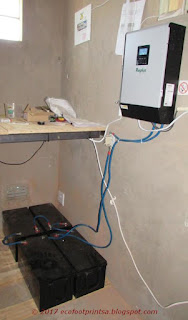
4 X 200 Ah lead crystal batteries
 and the Replus charge controller
 and inverter combined.

S'funny - you would think that a couple of low wattage lights, a TV, decoder and wi-fi (+/- 40, 35 and 30 watts respectively or +/- 120 watts together) would be easy for a system to handle.  But, over the course of an evening (4 - 5 or more hours) that equates to 600 + watts.  Add that to the fridge which runs for 12 minutes every 8 (on for 12 minutes off for 8 minutes ) and power consumption at night was generally working out to be higher than the entire house during the daylight hours.  We were consuming +/- 2 - 2.5kWh at night - when no power was coming into the batteries and the 6 X 2 volt batteries (when it was overcast for extended periods) were sometimes battling to handle it on their own.

Now that the load is shared - I am even able to use my 1200 watt hair dryer for 8 - 10 minutes (once a week) - providing that I use it during daylight hours - and have allowed the batteries to have a bit of charge before I place such a high demand on them.  So, until about 9.30 - 10.00 a.m. my hair drips dry.  Thereafter I am able to give it some semblance of a style.

Definitely no more power worries in this house anymore.

Cost?

For a stronger, more powerful system it was approx. 50 -55% of the total cost of our original solar set-up.

Sometimes I get giddy at the amount of power I now have at my fingertips... :D

Our old system, which is 5 years old, has paid for itself.  5 years of powering our home / business "head office" - if we has used grid power we would have paid more than the original system cost us - for the rural levy only (+/- R680.00 / month)!!!  The cost of the KWh we used would've been added to that.  Our old system is still going.  And now it's life is extended because it has "help" :D

We will not have to switch off our lights for Earth Hour tonight because we, personally, don't need to protest against our power being supplied by coal fired nor nuclear powered power stations - notwithstanding the power required to produce the various components - for only the sun is providing the power for us to use.

However, for the sake of this planet - long term - and for the sake of romance, we will be using only candle light tonight... :D


Disclaimer:  Products mentioned on this blog posting are products we have purchased for our purpose.  That does not imply they will be sufficient for your requirements / purpose.  No supplier is aware, nor has paid us, for mentioning their products.


For info on how you can obtain your own Foothills DryAway solar / wind food dehydrator please click the link.

Tuesday, 7 July 2015

Nkandle

How many of the readers of this  blog have heard about Nkandla?  Our presidents (and his family's) retirement plan?

I also don't know how many people overseas have heard about the load shedding (enforced blackouts) taking place in this country as a result of our power utility (Escom) not having the foresight / planning to anticipate demand in future years, and not maintaining their existing resources.

It's hectic.  Power has been going off for 2 hours once a day, twice a day or even three times a day - depending on the strain on the power system, and their collective power generating capabilities.

It even affects us - as our ISP's radio towers go down. (Thankfully, we still have our smartphones so we're not totally disconnected...)  We're very grateful though, that we don't experience the complete blackouts that the majority of the country has to suffer through.  Thank goodness for being off grid.

I saw this somewhere recently and thought it particularly apt...

N'candle - a play on Nklandla.

That's basically the situation.  Candle power rules for all those who don't have an alternative source of power.

Btw, on googling various images of Nkandla, I notice the "retirement dwelling" has no visible solar panels...  That was shortsighted of the architect.

Saturday, 9 May 2015

Still baking...

The banana bread recipe that came with my Ma Baker bread machine was a disaster.

Although in the true sense of the word banana bread isn't "bread", but is actually a banana cake, which is baked in a loaf pan.  Which is probably where it gets it's name from...
The banana bread recipe from
my Ma Baker information / recipe
booklet
But, was the disastrous recipe the machine's fault or mine?  I dunno.
Dense and heavy - more like bread than cake
Nowhere in the recipe does it say anything about removing the mixing paddle.  But, although it needs initial mixing to combine the ingredients, it wouldn't need the paddle later in the recipe because the recipe doesn't contain any yeast.  So, hesitating, I left it in.

The result.

It was heavy, dense and stodgy - although it did taste like banana bread I wasn't happy.

So I went searching for a bread machine banana bread recipe, and found one here or at the end of this posting.
My second attempt - light, aerated, and definitely
banana bread - or should that be cake? lol
The changes I made to the recipe was to prep everything before placing the already mixed wet and dry ingredients into the baking pan - and I omitted the paddle.  And I used the "Bake" cycle, not the "Quick" one - which included mixing at the oddest times during the baking process.

Ah - that's more like it.
You can visibly see the difference between the
two recipes and resulting loaves.  The booklet
recipe loaf is on the right, and the new recipe is
on the left.
This was definitely banana bread as I know it.
660 watts - that means the Ma Baker, on
bake cycle, uses only 448 watts
(by deduction)
With the fridge (132 watts) the decoder, wi-fi and laptop (+/- 35 + 10 + 35 watts respectively) and the bread machine all working simultaneously, the Owl electricity monitor was displaying 660 watts.  Which means that the bread machine was only using 448 watts.  Now, can one possibly bake a cake with less power? ;)

My final question:  those that have, and use, bread a machine - do you use it for anything other than baking bread / cakes?  If so, would you care to share?


Ingredients  Serves: 10 

·        2 1/4 cups (280g) plain flour
·        1 teaspoon baking powder
·        1/2 teaspoon bicarb soda
·        2/3 cup (150g) caster sugar
·        2 tablespoons (40ml) vegetable oil
·        2 eggs
·        2 bananas, peeled and halved lengthwise

Directions
Preparation:10min  ›  Cook:50min  ›  Ready in:1hour 

1.      Place ingredients in the pan of the bread machine.
2.      Select the 'Dough' setting, and press 'Start'. Mix the bread for 3 to 5 minutes until the bananas are mashed and all ingredients are thoroughly combined. If necessary, use a rubber spatula to push the dough from the sides of the bread pan. When 3 to 5 minutes have passed on the clock display, press Stop. Do not continue mixing.  I sifted at the dry ingredients together, beat the eggs gently, mashed the banana and, mixing those two together, added the oil.  The wet mixture was then carefully added to the dry ingredients and the mixture was placed in the Ma Baker - sans the paddle.

Then I continued as the recipe states:

3.      Smooth out the top of the loaf with the rubber spatula.
4.      Select the 'Bake' setting, and press 'Start'. The 'Bake' cycle time may vary with machines, but should be about 50 minutes. To test the bread for doneness, insert a wooden skewer into the centre top. Remove the stick. If the bread is done, the stick will come out clean. If there is dough on the stick, reset the machine on Bake and continue to bake an additional 10 to 15 minutes. Test again to assure the bread is completely baked.
5.      Remove the pan from the machine, but allow the bread to remain in the pan for 10 minutes. Remove the bread to cool completely on a wire rack. 

Wednesday, 11 February 2015

Reality of solar power costs

I get many e-mails, especially from others in South Africa, regarding our move off-grid.

So many people in South Africa are totally fed-up with Escom's load shedding shenanigans (enforced blackouts) and are eager to go off grid, but I think that the unknown cost of that is inhibiting most people from making the change. Perhaps it would be easier if I broke down the cost of our 1.12kWh solar system.

First, though, when we left our town house and moved to our smallholding, we were using approximately 15kWh / day.  At the time that was costing us ZAR1.37 / kWh.  Therefore 15kWh / day was costing us ZAR616.50 / month.
Minimum grid power costs over 5 years if we
had stayed 
in our town house
As you can see from the above, if we had not moved to our smallholding and gone off grid we would have spent approximately ZAR54 271.20 (excluding V.A.T.) over a period of 5 years.  And that is calculated at an annual increase of only 8% / year.
The minimum grid power costs over 4 years
on our smallholding 

- if we had availed ourselves of the service
Plus, if we had continued using Escom on our smallholding we would have had an additional service fee at a cost of ZAR589.00 - ZAR715.93 per month.  But, our electricity bill would have been even more than the total monthly amount in the image above.  Our smallholding neighbours spend on average ZAR 1200.00 - ZAR1500.00 / month.  Why - because they are not aware.

So - now to the costs of our solar power system.

As you can see from the above our system cost us ZAR54 886.39  That was back in 2012 - the cost of solar panels is lower now than it was then, so that cost would be reduced even further.

To me there is no comparison.

We live quite normally.  You just earn to become more aware.

If you discover that you require the use of a fridge and a freezer, and you don't have the power output for 24 hour use of both, then, if you are able to purchase a better energy rated side-by-side fridge /freezer unit, as opposed to plugging in a separate fridge and a freezer, you can have that requirement fulfilled.

Similarly the washing machine.  Front loaders use far more energy than a top loaders, and a cold water wash will clean 99% of your clothing as well as a hot water wash will do.

Selling on your now redundant appliances helps to offset the cost of the new ones.
Our Owl electricity monitor
We  have become completely aware of exactly what appliance / gadget we switch on, and for how long.   Providing you keep your eye on how much power your panels have produced (via the charge controller), and, with the assistance of the Owl electricity monitor (or similar), how much power you have consumed, then you can judge what you can switch on at any time on any given day.  This is especially true on wet, rainy days when less power is being produced.  Funnily enough, dry overcast, or cold sunny days often produce more power than full sun, hot days, This is because the heat generated by the sun on the solar panels reduces their efficiency.

For us, the current scenario is that in comparison to what grid power would cost us, within a maximum of 3 - 4 years our solar system is producing electricity for us at no charge - with absolutely no electricity price increases amortised into the cost of it's set up :).  The panels have a 10 year lifespan, and the batteries a 20 - 25 year lifespan.

Now, if only Escom would, firstly, agree to more sustainable power production via solar panel and wind turbine farms, and, secondly, allow for those who produce their own power to feed their excess back into the grid, then perhaps they wouldn't be in the mis-managed, shortsighted position in which they are now finding themselves - a position from which the whole country, and it's GDP / current and potential international investments, are suffering...

There you have it.  The nuts and bolts costs, and pro's and cons, of installing and living with solar power.

Friday, 2 January 2015

In for a penny...

...to save a pound in the long term.

Being a typical female I have been very, very grateful for my 320lt LG larger-than-the-undercounter bar-sized Defy fridge that we originally had here.

But, the LG was an 8-year-old fridge (B rated??) and it was chowing away at our stored solar power.  And it had a small freezer section with just enough space to hold a week or so's worth of food.  Plus, the fridge was always chockers - and needed re-arranging everytime I wanted to add something new to it's innards.  (Those damn half-full homemade sauce / jam / mustard bottles - they always take up so much space in a fridge, don't they?)

At the end of last summer I decided that I needed a freezer big enough to hold excess harvests from my garden.  It's just as well that I made that decision - as i found out 3 months ago that our local, and the only glass jar manufacturer in this country (Consol) has decided to stop making their preserving jars with the metal lid and metal ring seal!!!  What is wrong with them?

Anyway, I digress...  I have a chest freezer, but simultaneously adding the daily electrical consumption of a chest freezer to that of our old fridge would not be an ideal situation for our limited solar power.  It would effectively double up our power consumption.  Which we could handle in summer, but wouldn't be good in winter.

So, a-googling I went.

There are plenty of (expensive) imported A+ and even A++ fridges out there and which are actually available in South Africa.  But, I'm not looking to take out a bank loan.  Nor is RMan.

So, in April 2014 I wrote to the Defy manufacturer in Durban to find out if they had an A+ fridge.

Nope.

Nothing.

At that moment.

But, they were planning on releasing their latest model available from the end of September 2014.  And it was going to be an A+ model with a consumption of 484 KwH / year - roughly 133KwH / 24 hours.

Perfect.

I can wait.

I have patience.

Sometimes.

You cannot purchase directly from them (have they not heard of factory shops?) and have to purchase a Defy through a retail agent, and our closest one was the co-op in Swellendam.  I spoke to the lady in the kitchen appliances section and, after giving her the model number I had been supplied with by the manufacturing company, I asked her to please make a note in her diary and if she wouldn't mind contacting Defy closer to the time.

She did.

To make a very long story short (regarding Defy's web page and their displaying 3 models all with the same model number, but which are completely different fridges, one of which was ordered by the co-op, delivered to me, and swiftly returned the same day as incorrect) I finally, with the assistance of the Coastal Divisional Manager, received the correct fridge on Monday, 22 December 2014 - three weeks after I took delivery of the first incorrect fridge!!!  It seems none of their sales staff knew which was their latest model and which consumed 484kWh / year.  Hmmm....?

But, all's well that ends well.  It's a cracker :)
554 ltrs of
fridge and
freezer space :)
It uses only 1.33kWh / 24 hours compared to the old LG which used 2.1 kWh / 24 hours.  That gives us roughly an additional 800 watts - per day - to use on other things, or to be available during those dark, totally overcast winter days when the lights go on earlier and running the PC or laptop is required.
A+ rating with plenty of storage
 space
It's a beauty too :)
The old LG fridge freezer on the right
and the new Defy side-by-side A+ model
on the left.  I had hoped to get a white
model, but that will only be available
in February 2015.  I don't have that much
patience LOL so the stainless steel look
will have to do.
I have gained 120% more freezer space, and 98% more fridge space.  Nothing wrong with that, is there? :)

I have cleaned out the old LG, spruced it up, and it will be sold on - thereby recouping some of the cost (roughly a fifth) of the new Defy.  The chest freezer? We debated and came to the conclusion that we will keep it - just in case something goes wrong with the new fridge/freezer and it has to go in for repairs. I'd hate to have to throw away a whole bunch of (mainly frozen) food because I have nowhere to store it.  The chest freezer is in the garage, and is not in our way.

I was very chuffed, because it arrived in time to freeze the very last of the strawberries and youngberries, and will also hold home grown tomato puree ice cubes, and peppers, swiss chard, carrots and beans, etc for use when they are out of season.

Sometimes you have to spend a bit to save a bit in the long term.

Why?

Well, not only does this freezer now allow me to freeze a good portion of what I harvest, but this larger fridge / freezer will also make it possible for us to only have to go through to town once every 10 - 14 days, instead of every week, thereby saving on the fuel cost / transport footprint.

Happy days :)

Sunday, 7 December 2014

"Let the sun shine,

... let the sun shine in..."

South Africa has finally switched on it's solar power.
Jasper solar farm - near Kimberley
http://thegreentimes.co.za/africas-largest-solar-farm

-now-fully-operational/
With a rated capacity of 96 megawatts, Jasper will produce about 180,000 megawatt-hours of clean energy annually for South African residents, enough to power up to 80,000 homes.

And, they have already started construction of another solar farm called Redstone which is located near Jasper - and this one will provide 100-megawatts of CSP.

Sigh - I'm so frigging happy :)

Now, if they could only just plan another couple of dozen solar and wind farms around the country immediately then perhaps we wouldn't have the load shedding that that the rest of the country is currently experiencing...  They are both quicker to erect, and can provide power faster than it takes to construct a coal powered or nuclear powered power station.

Going to Swellendam yesterday for our weekly shop, most of the businesses had their doors closed and locked as they had no generators to power their lights / tills whilst Escom enforced a load shedding to "build up reserves".  How can those businesses survive if they have to close their doors on a (busy) Saturday morning - especially one 2 weeks before Christmas?

Petrol stations in Cape Town are apparently running out of diesel.  Why?  Because Escom is using the diesel to run power plants.  This lack of diesel has far reaching consequences for businesses and transport.  For the country's GDP.

Perhaps those in senior positions at Escom should find themselves trapped in a (stationary) lift for 2 - 3 hours, or visit a public loo in the dark - all because they (and their predecessors) were too short-sighted and didn't plan adequately years ago for the country's future electricity requirements.  "Use less / save power / switch off unnecessary equipment" Escom says.  But, if everyone does as they request then their sales will drop, their income will thus be affected and that means they will have another bloody excuse to hike up the electricity prices to meet their ludicrous financial commitments / loans.  All because they didn't do their research / fulfil their job specifications adequately / plan properly.

Escom is making this country a laughing stock.  Who wants to invest in a country which can't supply electricity to the people or to their businesses?  A country which is also running out of diesel because the only power producer in the country is apparently using it all to run their open cycle gas turbines?  Oh, and never mind the diesel required to fuel the 200-odd fleet of trucks running 24 hours a day delivering coal to Majuba because yet another tender company took a shortcut. (the silo's weren't constructed properly and are either cracked or have collapsed).
Try installing solar power at your home - even
if it is only enough to power the most urgent
of our appliances (lights, fridge, chargers).
  Living with only the power produced by the sun
encourages you to be aware of each switch you
turn on, for how long and when.
Personally, we're loving the freedom it provides as
opposed to the perceived restriction on the number
of appliances we can run.
Back to "basics" is a pleasure :)
Forget coal, forget nuclear - solar and wind power will, and can, provide for our needs, Escom.  Wake up, for goodness sake!!!  Before this country loses all credibility.

Saturday, 15 November 2014

The scars recede

I have always felt guilty about the scars we have caused on our land.  Scars from earth moving, creating our dam, planting our trees and, most of all, the scars caused during our building process.

Google Earth has finally updated the images they capture in our part of this planet.  Being out in the sticks (and therefore unimportant) they only do so every three years, but - it was worth waiting for :)

This is what our piece of land looked like when we purchased it back in March 2008:
Our plot of land in March 2008 when
we purchased it.
The path that crosses it is the footpath
caused by our one neighbour - a shortcut
across the field to shorten the trip to the
main road 4.5 kms away.
Also interesting is the plough line
which transgresses both our plot
and the neighbouring one.  I can tell
you that the fence that divides the two
plots is old and rusty - so the
scars of that plough have lingered...
It was completely overgrazed by the locals cows and sheep.  And full of renosterbos - all those little individual dots are visible on the Google Earth screen print. Signs of ploughing from yonks ago - and who knows when that last happened. Certainly long before 1996 when the smallholdings first started being sold off and inhabited by "newcomers" because the oldest resident has no memory of that fence not being in place.
Our plot of land with phase 1
of our build - one large room
(consisting of the lounge / dining /
kitchen) and the white shiny IBR roofed
bathroom to the right side - Aug 2010
Then, we got involved and scarred the land with our personal requirements. The driveway round the (dryer side of the) perimeter,  The dam.  The grape vine area.  The vegetable patch and the underground cellar which we never completed / built.  And the house build.

Ugly, nasty scars.
Our plot - October 2013
But, this is what our smallholding looks like from "space" in October 2013.
Our plot with markers.
You can even see the solar
panels n the garage roof :)
(Still enough space to
triple up on that if we had to
/ wanted to)
To give you some idea of what lies where, I have labelled the various area's I mention in this blog.
Our home November 2014 :)
I am strangely comforted by the latest Google Earth images (even if they are over a year old), because I finally realise that no matter how we bend our smallholding to our requirements, if we were to leave it, permanently, and no one was to occupy it ever again, all the buildings would collapse, the rubble would become overgrown, and it would revert back to what it was originally.  It would no longer be scarred by the mark of man.

In the meantime though, we are trying to treat it gently.  We are trying to be good custodians.  And we are aware of our impact - even if it is only on 2.2hA of land.

Saturday, 28 June 2014

Powered up...

Warning - this is a l-o-n-g posting, and picture heavy...


A few days ago I mentioned that we had some very exciting happenings at the farm.

Well, here is the news...

We have learnt a lot about our solar power installation through trial and error. When we initially installed our solar panels we were not informed about a number of things which were vitally important.  In this instance, we were not informed that low temperatures affect the performance of solar panels.


When the ambient temperature is below 10oC the cold affects the voltage of the panels - causing the voltage to spike.  We had all our 12volt panels (incorrectly) connected in series - all the way through to our charge controller. Connecting them in series meant that maximum volts were produced by the panels - which is what RMan was (mistakenly) aiming for.  (connecting the bank in parallel would mean the Outback charge controller would utilize the Amps produced, not voltage.)

We have an Outback 80 charge controller, which, translated that means it can handle an input of 80Amps and 145 volts power from the solar panels - maximum.
Our indoor Outback remote display gives us the
first /indication that all is not well with our
power production.
Silent - at 9.40a.m. in the morning -
is not good news.  It means the voltage
from the panels is spiking
What we discovered last year (winter) is that at sunrise, when the temperature is the lowest, the cold caused the panels to spike over 145 volts - the maximum the Outback charge controller could handle - which caused the charge controller to shut down.  For hours.  Which resulted in lost input charge to the batteries.

Checking in the power room, the Outback
charge controller tells the tale : 148VDC
High VoC = shutdown - to prevent damage
to the charge controller
Given the number of people world-wide who are off-grid and who rely on solar power to charge their storage batteries, I did not believe that the problem was unsolvable, so after contacting a number of people locally - who didn't help much - I went international.  An extremely helpful gentleman at Outback technical support in Australia, responded to my high voltage e-mail query. And, over the course of 16-odd e-mails [I told you you he was extremely helpful :) ], he advised us to reconfigure the panels.
Diagram of the new configuration of our 8 X
off-grid solar panels connected in series and
the two banks connected in parallel.
He suggested that we have two equal banks of panels linked in series, and then link the two banks in parallel with two breakers separating the two different guage cables between the panels and the charge controller.
Wiring into breakers
prior to being routed
through conduit
Breaker details
To do that we needed an equal number of panels.  We only had 7 (6 X 140watt and 1 X 135 watt).  Wayne, our SiL across the field, had two 140watt panels that he wasn't using, so we purchased them off him - thereby removing of the 135 watt panel from the exisiting array.  These 8 panels give us 1120 watts of potential solar power going to the Outback 80.
6 guys in the front and two guys behind -
installing our first 5 X solar panels in August 2012.
Plus, RSon had the very good suggestion of re-installing the solar panels in such a way that we would have available roof space if ever we wanted to install more panels in the future (our old existing installation "hogged" all the available space of over half the roof area).

But, that meant getting all the panels down off the 45° pitched roof.

You recall how the builders assisted us in installing the original five panels on the garage roof.  7 guys helped RMan that day.  Five in the front with RMan...
 ...and two holding support ropes at the back.

This time we only had RMan, RSon, Wayne and one of the locals we roped in to help.

I was fraught with fear.  Those panels are frigging heavy.  And the pitch of the roof is hectic - and not condusive to ease of clambering all over it.

The scaffolding was errected, and the removal proceeded at 11.00 a.m. on Saturday morning.  I was torn between not wanting to watch / document the event, but being aware that the more I photographed, the more info we would have if we ever needed to check something in the future.
RMan and RSon discussing the best way to handle
this enormous task - and RSon giving us an
idea for the addition of further panels in future
RSon, ever the adverturous one, elected himself to climb to the roof apex in order to connect the supporting ropes to the exising array.  And to loosen the existing bolts securing the solar panels to the roof...
RSon, Wayne and the helper trying to get the
panels off the roof
A couple of times I remember pointing the camera, closing my eyes and clicking the button.   I couldn't watch...


Since the first time we installed the panels, we have erected a carport roof - and that carport roof was in the way when it came time to secure the supporting ropes.
The carport roof was in the way, so we had to
secure the supporting ropes to a quaddie
 It was very hot and difficult work - with awkward access all round.
Removing the old cables so that we could get the
panels down
But, my fears aside, naturally they got the panels down in one piece, and without injuring anyone.  There is a God in heaven.
Checking and rwiring the panels and re-fixing them
to the horizontal aluminium square tube supports
We had purchased more cable with which to rewire the panels - and that was just as well. We discovered that one of the old cables had become pinched during the original installtion - and that was not good news!
As we are going to be installing the panels in a different configuration, the supporting beams inside the garage roof had to be moved as well.
The horizontal beams fixed to the trusseses
support the solar panels
(Ah - a small bit of news I forgot to give you - RMan managed to break his new-ish glasses a few weeks ago, and, although new ones are already on order, all close up work has to be done with his prescription sunglasses.

Inside a garage roof??!?!)

Wayne to the rescue again LOL
Oh, brother!!!!  The roof mounted bolts were
installed in the incorrect position
Once everything was rewired and refixed to the aluminium supporting structure, the first bank of 4 panels was once again hoisted up the scaffolding and onto the roof.
RSon at 5.59p.m. - perching like a monkey
 on the rooftiles in the fading light.
I definitely gained a few grey hairs watching him...
Does he know how long 9 months carrying a
child is, and what is involved in getting that child
to adulthood?????
All of this takes time.

They started at 10.30-ish in the morning and, at 5.59p.m. the first bank was more or less installed.  They had installed the securing bolts from inside the roof outwards.  Then trying to find the holes on the aluminium structure below the panels wasn't easy in the fading light - and it took ages.

So, Sunday morning the work continued...
Getting the securing bolt lined up with the hole
in the roof tile
The securing bolts for the second bank were installed from the outside in i.e. first through the aluminium square tube and then into holes drilled through the roof tiles.  Far easier.  Even given the raging gale that inconveniently sprang up to hamper the operation.
The new two banks of 4 X panels - using less roof
space than the previous installation - and producing
200 watts even in the cloudy weather evident on
the photograph.  This installation allows for a
further 8 panels to be installed in the future.
So, finally we have two banks of 4 X 140watt panels (which are connected in parallel this time) mounted on the roof again.

And - thanks to RSon's foresight, we have space to install a further 8 - 12 panels should we so choose in the future :)

Clever boy :)
The battery / inverter connections remain the same
So - there you have it.

The next day it was immediately apparent that there is a definite, and visible, improvement - 10 minutes after sunrise we are already getting a charge going to the charge controller and 30 minutes later over 300 watts is being produced.  With nada voltage spiking / shutdown occuring.  At the end of the day, we are obtaining 5KwH+ of charge to the batteries - in winter!!!! :) That we only achieved last summer.

And - there is no more over voltage spiking :D  So every scrap of power produced by those panels from the moment the sun hits them in the early morning to the last ray in the evening is now going to the charge controller and into the batteries.  Yipeeeeeeee!

Well done guys.  And, thanks - seriously - a very sincere and grateful thank you for all the work, willingness, thought and effort that you all expended to sort out our power problems.


By the way, tomorrow we will have been here for exactly 2 years :)  How fast the time has passed and how worth the move it was.  No regrets - neither RMan nor myself :)


P.S.  You have only 2 days left if you'd like to add your name to the piquanté pepper seed giveaway.  Entries close at 6.00p.m. on Monday, 30th June 2014 :)