"Self-sufficiency does not mean 'going back' to the acceptance of a lower standard of living. On the contrary, it is the striving for a higher standard of living, for food that is organically grown and good, for the good life in pleasant surroundings... and for the satisfaction that comes from doing difficult and intricate jobs well and successfully." John Seymour ~ Self Sufficiency 2003
Showing posts with label lemon tree from pip. Show all posts

Saturday, 2 January 2016

Are we strange?

Most people celebrate New years Eve with a party, or a special meal - in years gone by that was something like prawns, occasionally freshly caught lobster (when RMan went out in his boat and cast out his crayfish nets), etc.  ( I didn't go cray / lobster fishing with him often as the horizon wouldn't stay still for long enough...  Mind you, the couple of times I did go with him, I fed the fish quite adequately, so we were sort of giving back whilst we were taking ;) )

But, we don't make that much of a fuss about New Years these days.

Although we do tend to stay up long enough watch the international fireworks displays on TV - New Zealand / Aussie / Hong Kong and Saudi - we haven't made it to midnight in years.  We prefer to get a good night's rest - because the first morning of the year is just a normal new day on our smallholding, with animals which need our attention, and crops which need watering / weeding / harvesting.

And, forcing oneself to stay awake until midnight to have a quick burst of "excitement", and then hit the sack seems - well, almost pointless to us.

But, I do try and cook something, no matter how simple, which we've not had before, and this year was no different.

John, from Going Gently, has raved about Scotch Eggs for yonks.  I've never tasted a Scotch egg, let alone made one.

On New Years Eve all that changed.

We have fresh eggs from Tweedle Dee and Cluck - so why not? ;)
The simplicity of the plateful belies it's taste -
it was scrumptious :)  The remnants of my first
piece of cornbread is skulking behind the lemon lol
Using Jamie Oliver's Scotch Egg recipe guidelines, I thawed some Elgin Free Range chicken sausage to wrap around the hard boiled eggs - adding some homegrown chopped chives and parsley to the sausage meat which I had squished from the casing.

Then, I carefully dunked the sausage wrapped egg in milk, and breadcrumbs, and again in milk and breadcrumbs, and then left them to rest in the fridge until I was ready to cook them.

Deep frying them for 6 - 7 minutes (turning twice as the oil only came ¾ up the sides of the eggs) until the crumb coating was nicely browned, they were served with the juice from a freshly picked lemon, some homemade corn bread, homemade gherkins, and sliced cheese.

Conclusion?

Bloody marvellous mate!! :D

But, very filling...

As we couldn't finish the four I cooked, we left the remaining 1½ eggs covered overnight in the fridge and then had them for breakfast on New Years morning.

I honestly don't know which tasted better - the freshly prepared Scotch Egg or the chilled breakfast version :)

Sunday, 22 November 2015

Water security


With the higher than normal temperatures we have already experienced this summer, we purchased an additional two 5 000lt rainwater tanks and, against all logic, RMan threw an enormous slab so that we could position them by our fruit trees.  "Against all logic" because that position is far away from the gutters which collect the rain water.

But, we had a plan ;)

They will be filled by the rainwater that enters the tanks by the house and which will then be pumped up to them via our electric pump once our solar batteries are charged and are on "float" stage.
The two new tanks - over thereeeee in the distance
Digging that +/- 45mtrs of connecting pipe into the ground wasn't easy - the ground is rock hard already.

The solar panel has been concreted into the ground
to prevent it being blown away during the south
easter.  Ditto the placement of the panel on the
western side of the tanks.
We had an extra solar panel, and an old Phocos 40 Amp charge controller, so, after purchasing a 12 volt water pump (roughly ZAR800.00), RMan set about connecting it all up. 
A lidded black storage tub has become our "solar power" point by those two tanks.
All the solar paraphernalia housed within the
black box
The deep cycle battery, the small Phocos charge controller and the 12volt pump fit perfectly inside the tub.  Small holes were drilled in the upper wall of the tub for ventilation.  (The holes were purposely drilled too small to allow snakes or rodents to take up residence inside the tub.  You don't need that kind of surprise on opening the lid.) 
The outlet pipes leading to the 12 volt pump inside
the black tub / box
RMan joined the pipe connecting all 6 of the old rain water tanks to the top inlet valve on the new 2 tanks.

Then, the front bottom outlets on the 2 new tanks were joined and connected to the 12 volt pump.  
12mm pipe coming out of the pump and leading to...
But, the length of the pipe leading from the 12 volt pump to the (1) lemon trees) and (2) fruit trees / grape vines was just too long to properly water the trees - they got a mediocre sprinkling not a deep watering.

So,we have installed two valves on the 12 volt pump outlet pipe.  That way we can either water only the lemon trees, or only the fruit trees / grape vines.
...the two valves.  The valve on the left
leads to the lemon trees, the one on the right
to the fruit trees / grape vines
Now, at last, we will be able to give the trees / vines on the "orchard" line a proper good soaking once a week.
The pipe layout to the lemon and fruit
tree orchard
Using gravity to water the lemon trees only took 3 - 4 hours of hand holding / moving the pipe every week.  The new setup means that all the (lemons, fruit and grape vines) will literally all be deep watered within 1.5 hours max.

Now, we just have to figure out how to prevent the mousebirds from eating all the fruit... ;)

Sunday, 15 November 2015

Arrival and departure

Long time followers of my blog (are there any left lol?) will remember back in 2010 I planted some lemon tree pips in soil.
Lemon pips harvested in 2010
They grew...
Early 2011

And grew...
January 2012 - the second lot of three rows
was planted

2014 - the lemon trees are definitely growing
Until they decided that the time was ripe to send forth some fruit.
October 2015 - bearing fruit at last
This week I harvested the first of my home grown lemons.

All 236gms of it.
Our first lemon produced on a tree
grown from a pip :)
('scuse the dirty scale, it's my garden produce scale :)  )

It was absolutely delicious squeezed over our butter and garlic fried hake last week.

Then - on to the departure...

Tweedle Dee decided that he didn't like being ostracized by Tweedle Dee whilst she raised her chicks.  And he turned downright mean and nasty.

To the point that neither Scallywag, our dog, nor I, could venture into the garden without being terrorized / attacked by him.

Proof?
Damage inflicted by Tweedle Dee to the back
of my leg
The sod perfected creeping up very silently behind me and attacking the back of my legs.

So, I spoke to our neighours to see if they would like him back.  it was either that, or into the pot with him - not that RMan and I would do the deed.  We couldn't willingly kill an animal - we're just too soft.

Thankfully, they accepted his return with extremely good grace - and apparently he is ruling the roost together with a larger rooster.  With roughly 30 hens between them I'm sure his days are very occupied...

RMan and I can now happily roam the land again without fear of attack by a sodding rooster!!

As for Tweedle Dee - she's more than happy to care for her chicks without fear and intimidation / an over eager suitor.  Let's see in the months ahead if she has produced a rooster of her own...

Saturday, 5 September 2015

Fruit in the making

Spring has definitely sprung in my part of the world.

Those in the Northern hemisphere are winding down their gardens and looking forward to a time of rest and contemplation - after all their preserving is finished naturally ;)

Plum tree blossoms
But, here - there are signs of life everywhere.  I took a walk round the garden this week and happily snapped at the various signs of spring...
Apricot tree blossoms
 ... the plum trees blossomed weeks ago, and the fruit is already setting.

The apricots are slow - only a few blossoms, but enough to get the taste buds tingling in anticipation.
Pear tree blossoms
My personal favourite - the pear tree blossoms.  We only had a couple on the trees last year (due to my incorrect pruning) so to make up their display is stunning this year.
Youngberry cordial in the making... ;)
The youngberry bushes - a few blossoms are starting.  This is the one fruit that I want plenty of.  The youngberry cordial I made at the very end of last season was stunning, and I am definitely devoting 80% of the harvest to making cordial this year.  (and, yes, Dallas, I haven't forgotten you would like me to share the recipe ;)  )
Lemon buds, blossoms and fruit -
will the tree finally hold it's fruit?
 The lemon trees are blossoming - and still trying to hold onto their fruit.

Borage flowers.
Can you spot how full this bee's pollen sack is?
The bees are everywhere - trying to get into the house, on the fruit trees and on the borage flowers...

The mature lemon tree is also bearing blossom - and has a decent amount of fruit ;)
Eureka Lemons - with RMan on the John Deere
 in the top left corner of the pic.
And, kymber, your pineapple sage is flowering once again.  (Is it seriously a year since I last posted a pic of the pineapple sage???) 
kymber's Pineapple sage
As welcome as Spring is, we didn't really have a winter.  We woke to frost only 3 mornings this whole winter.  And nothing like the thick layer of ice on the trailer cover either.

To illustrate how mild the winter was...
Last seasons granadilla's are still ripening on
the vines
...my granadilla plants still have granadilla fruit ripening on the vines...
Aubergine (eggplant) forming on the
plant I managed to protect from
last season
 ... the one eggplant that I covered with a small piece of shadecloth to protect it from the frost, is still alive, and about to burst into flower...

And, most ridiculous of all - all my piquante pepper bushes are still bearing fruit?!
My piquante pepper bushes are still bearing from
  last summer???!
I'm not finished with the "winter-we-didn't-have-this-year" - surely there are still some Rosie days left this winter...???

But, I also now understand why I don't seem to preserve as much of my various harvests as those who live "up north" do.  Because we seriously have such a short winter it seems that no sooner have I finished preserving than the next crop is on it's way.

On a shelf in the carport, I have more than enough pumpkins / butternut to see me through until the next harvest.  It was an excellent harvest last summer - providing us with more than we could use, so I was able to supplement my children's larder too.

Tomato puree / concentrate / and sauce (ketchup) and sundried tomatoes I will always preserve.  The same with various homegrown fruit for jams and cordials.

But, very gratefully, I always seem to have either peas or beans of some form available in the garden.  The same applies to beetroot / swiss chard / carrots / lettuce / onions - they grow year round here.

Garlic - I seem to battle with that.  But, it doesn't stop me from trying ;)

The only veggies which are definitely winter only are cabbage and cauliflower - that's winter fodder for us :) (and the alpacas lol)

Given our abnormally mild winter (global warming / climate change?), I fear that this year's summer is going to be extra-ordinarily hot, so RMan and I are taking steps to protect our veggies / fruit trees / plants however we can.  But, more on that in my next posting...

Saturday, 4 July 2015

'N Boer maak 'n plan...


(translation of the title of this post : a farmer makes a plan)

There are roughly 40 lemon trees in our orchard - 98% grown from pips, and the balance from cuttings.

Yeah, I know - what are you going to do with the fruit from 40 lemon trees?

I have a couple of idea's.  But I will have to wait until they actually start producing fruit in quantity (and hopefully quality lol).

So far I am getting flowers, and a couple of really small baby lemons, but 99.9% of those are falling off.  Why?  I have no idea.  We are feeding the soil, adding the ashes from the Rosie, keeping them watered, and have even put up more of the privacy wattle fence to protect them from the hectic south easterly winds which blow in summer.

My worm farm is also due an empty out - which means worm casings and worm tea.  And I intend using some of that worm tea on the lemon trees.

Which means I need a sprayer :)

I tried using a 10 lts spray bottle (which has to be pumped in order to create the pressure to use) slung over my shoulder, but found that it took 3 - 4 hours of back-breaking walking, and spraying, and refilling in order to complete the task.

We needed something more hard-core :)
I spotted this beauty (in the pics above) for sale, which would work with my quad bike.  But, at over ZAR10 000 (without the trailer in the far right pic) it's a bit more than we were prepared to pay.

So, RMan set to making one :)

We purchase a pump.  And a 100 lt water container.  And some tubing.  And some straight tube joins and t-joins.  And hose clamps.  And spray heads.  And a hand held sprayer.  And a couple of in-line taps.  And an electrical isolator switch.  And a ratchet tie (to secure the tank to the quaddie).  Electrical wires and cable ties we already had.

The pump and the container were the most expensive parts - the pump was + / - R900, and so was the container.

But, a bit of fiddling here, and a bit of fiddling there, and this is what we ended up with...
1  the outlet hose from the tank to the pump
2  the water pipe to the handheld pump
3  the water pipe to the back spray heads
4  the in-line tap "valve" to prevent water being sent
 to the spray heads when it is not required
5  an in-line filter from the water tank
 to the water pump
6  a return pipe from the pump to the tank with
 in-line  tap "valve" - to regulate the water pressure
 and redirect excess water back to the tank.
Note : I took these pics shortly after RMan had
 completed his construction and whilst he was on
 his first trial run.  He has since secured those
 wires leading to the battery with more than
 tape...
Now we are able fill the tank with the organic "muti" (translation : medicine - which in this case = nutrition), hop on the quaddie, start it up, and take a slow drive whilst we smell the scent of lemon blossoms:)
The pipe labelled 3 in the first pic leads to the 3 X
 spray heads (1) at the back of the quaddie in the
 pic above.  When the red in-line tap valve
 (below the tank and in the middle of the pic above)
to the the spray heads is closed, then the water
is pumped to the hand held sprayer only (2).
But, that tap also allows us to regulate the
flow of water to the spray heads and the hand held
 sprayer simultaneously - which means we can spray
from the top / middle, and down on the bottom
 branches at the same time when necessary
We can fill the tank with worm tea from the worm farm, or with tea from alpaca poo.  Being 100 ltrs the contents of the tank last ages - we have to fill it at least twice in order to do the lemon orchard.

That is soooo much easier than walking round with a shoulder strapped 10 lt spray bottle which entails having to keep stopping, removing, pumping (to increase the pressure) before re-hoisting it onto my shoulder again in order to continue spraying before the next re-fill - which always came too quickly lol.
The pump is powered from the quaddie battery.
When the pump is not in use, the isolator switch
1 is in the off / disconnected position.
2 shows you the in-line tap "valve" to the back
 sprayers
3 shows you the in-line tap "valve" on the
return pipe to the tank
And, by closing the in-line tap to the back sprayers completely, we can, if we so desire, feed the ground / root area only of the lemon trees, fruit trees, grape vines and my veggie patches by means of the hand held sprayer.

Clever RMan :)

The cost?  Just over a 1/4 of the cost of purchasing the "real McCoy" :)

Saturday, 14 March 2015

Pestiferous

Ants.  This year they are hectic - probably due to the lack of rain.  They are everywhere.

Climbing up the trunks of our lemon trees, transporting scale on their backs and spreading the honeydew everywhere they venture...

... laying in wait round my pumpkin patch so that when I go to water the pumpkins I have to madly hop around to prevent being bitten to death...

... heading for the sugar water bird feeders in their droves...
So, I had to give the birds a helping hand.
All it takes is a strip of sticky fly paper wrapped around the branch of the tree from which the water bottle is suspended.
You will, naturally, get some macho ants who venture onto the sticky paper.  But, they obviously don't have many brain cells - even after their compatriots have been well and truly stuck they'll still attempt it themselves.

About the only thing, in my book, that the ants are good for, is creating breathing area's underground with their nest building, or consuming other pests in the garden.  Such as dead mice from our mouse traps...
... or those nasty cutworm from our compost heap.

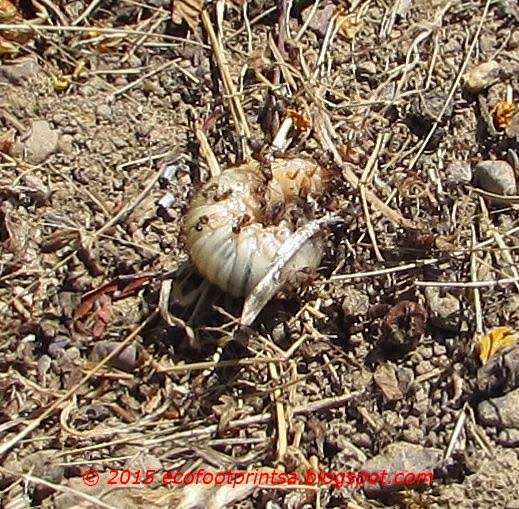
It took the ants exactly 3 minutes to make this large 2.5cm (1") cutworm stop wriggling.  And the  whole insect disappeared in about 2 hours.


Please - don't forget the piquanté pepper seed giveaway - you still have time to enter, and it can be found here :

http://ecofootprintsa.blogspot.com/2015/03/piquante-pepper-harvest-and-giveaway.html

Saturday, 29 November 2014

Eco-friendly weeding - part 1

Our land, like all the land here, is heavily (over)grazed by the local livestock. With that in mind, we finally had our soil tested this past October.  The results were surprising - at least to us.
Wherever the results are green - they are adequate  /good.
Wherever they're yellow - bad!!
The veggie hut and veggie patch - I knew they'd be good because over the past 3 - 4 years I have added at least two trailer loads of compost (that we had to purchase because, at that time we weren't making enough, quick enough) together with Talborne Organics and Starke Ayres organic fertilizers. Plus, in the last year they have also had a dose of alpaca poo - or two, or three...

I thought I had been feeding the lemon trees adequately - but the results certainly indicated that it wasn't anywhere near enough...

And, as for the oat field - RMan had added lime when he was planting the oat seed - and he thought he'd been generous.  He added +/-300kgs to a hA.

Ha!!  The results indicate that he (still) needs to add at least two tons!!

So, it wasn't just the lack of water that caused our oat harvest to be a failure. It was also that the soil imbalance was too great.
Potatoes growing in pots full of alpaca
poo.  On the bottom right are butternut

seedlings in a pot - and they're almost
ready to transfer to their designated
growing bed.
Then, whilst we were at it, we had the alpaca poo tested.  I have been getting amazing results from whatever I am growing in it (I have potatoes growing in neat alpaca beans at the moment, and they are doing briliiantly), but I was interested to see the actual figures.
The results of our ground alpaca poo
The gentleman from the laboratory was so impressed with the alpaca poo results!  He made us an offer we can't refuse...

Saturday, 26 July 2014

Long term planning


Anyone who grows their own produce knows that sometimes one has to be very patient. Very, very patient.

Well, this particular garden project started back in April 2010.

Growing lemons.  And growing them from pips.

I never knew that anyone could grow lemon trees from lemon pips until my sister-in-law showed me a heavily laden lemon tree in their garden which she says she grew from a lemon pip harvested from our town house lemon tree.

I had to give it a go, and ended up planting 30 small lemon trees which I had managed to grow from pips.

It has been a long wait.  With plenty of whoolly fruit fly infestations.  And many sleepless nights wondering if the trees we had planted were getting enough water, especially as they were all on their own - this was still when we were living in town, and only came out to our smallholding every 4 - 6 weeks.
Aaaaah!  What is this.
Finally, after 4 long years - a lemon bud has
appeared on one of my lemon trees:)
But, finally, a month ago I was rewarded.

The first sign that there was life appeared in the form of a small bud.
The instant reward of a lemon flower is it's
incredible smell
Talk about excitement.  I was beside myself!!  When the first flower opened I was beside myself.  In going to fetch RMan to come and see I think I cleared the distance from the lemon orchard and the house in 30 seconds.  Whooping excitedly all the way LOL
Perfection!
The perfection of the little lemon which has sprouted from that flower makes me want to weep.
The buds sometimes try to conceal themselves
but my eager eye managed to find them
I pity those who have never felt the sense of achievement which can be obtained from growing something yourself from what would normally be thrown into the rubbish or onto the compost heap.  There is nothing, absolutely nothing, which compares - no expensive must-have-latest-version gadget, no fancy house in the "right" neighbourhood, no material possession you could purchase, no job promotion.  Nothing.

It is such a simple joy.  And such a simple achievement.  And so immensely rewarding.

All it took was care - and patience.
An ambitious cutting
growing buds before it
has produced a single leaf
When I gave the lemon tress a pruning at the end of last summer I shoved the cuttings into some growth hormone, and placed each one into a pot of soil.  This eager little cutting in the photo above decided that it wanted to produce flowers before it had grown a single leaf!!!  Naturally, the flowers didn't last, but at least the sign of life and the promise is there... :)

Saturday, 31 May 2014

It's the little things...

So, being Saturday late afternoon / early evening, RMan is ensconced in front of the TV watching his rugby, and I am plonked in front of the laptop, chilled glass of white to hand, having my blogging time.

I have wanted to mention this for a few weeks now - I can't switch on the laptop everyday so I try and keep up with everyone's blogs via Blogger Dashboard on my smartphone, but not every blog allows me to comment using it. And I don't always remember when I am properly online to revisit those pages.  But I do read your blog postings - I promise :)

I love those crisp early morning before sunrise.  Picture me - RMan still fast asleep in bed, so I'm toddling down to the gate and back, round all the veggie patches / orchards, humming to the alpacas, and quacking to the two ducks - in my (warm) gown and crocs.  I can't wear my winter sheepskin slippers outside - they'll get too wet from the dew - and wet sheepskin slippers start to smell... :)   Cold damp (wet) feet can easily be warmed when I return inside, and that early morning time outside is too precious to be fussy.  But I am a veritable sight to behold - I don't care, for it's only the animals that can see me LOL

But, to get back to those early morning solitary rambles round the property - there are a wealth of things to see, but you have to look closely...
A traditional suspended spiders web
... spiders webs of all description - traditional...
... and a not so traditional web
... and, what I call the tunnel spider web.  Our "lawn" (wild grass) is literally covered with them in the mornings.  I'm not too sure how this spider catches anything, because even the dew just hangs there on the outer edges, and doesn't drip down into the tunnel, so I'm guessing that a small insect will do the same. But I do wonder what the point is of the tunnel?
The morning-after-night-before for this tardy bee
Our lemon trees loved the belated pruning I gave them a few weeks ago. They have all started sprouting new leaves.  I am keeping a sharp eye out for a sign of the return of the woolly fruit fly, so the lemon orchard is included in my early morning stroll.  Carefully inspecting the trees, I spied a bee on one - at first I thought it had been skewered onto a lemon tree thorn by a butcher bird.  As I looked closely, I saw it feebly moving it's one leg.  I am surmising that it stayed out too late the evening before, and didn't have the energy to find it's way home.  When I to checked this lemon tree after the sun came up, it had disappeared, so it must've got warm enough to make the homeward journey.
Finally, this moth flew in one night, and I found it on the dining table the next morning.  I have never see a moth with this pattern before.  Pretty, isn't it?

It isn't just the obvious beauty of this place that we love - it's the little things that count too :)

Saturday, 22 March 2014

Gutless skiniving pests


I woke at 5.15a.m. the other morning.

Taking a solitary walk in the quiet calm and early morning coolness of an autumn morning that is a welcome change from the sometimes overpowering heat of summer, and, is, to me, the very best way to start the day.

But, that morning I discovered that we have been infiltrated by a gutless skiniving pest!
The start of our lemon orchard in December 2010
Some of you may have been following my blog back in 2010 - 2011.  And you may recall my showing you the lemon trees that I grew from pips.  Well, this pest, who lurks, hidden, beneath the leaves of the lemon trees, has invaded our citrus orchard.

It is called a Woolly Wifefly and I have no alternative - I have to eradicate it. Pronto!

Why?

Well, to quote from http://www.cals.arizona.edu/crop/citrus/insects/woolywhitefly.pdf


"DAMAGE: Woolly whiteflies suck phloem sap, causing 
leaves to wilt and drop when populations are large. 
Honeydew droplets collect dust and support the growth of 
sooty mold; large infestations where copious amounts of 
honeydew are produced, can result in the blackening of 
entire trees. This reduces photosynthesis, resulting in 
decreased fruit size. Honeydew and sooty mold can also 
contaminate the fruit. Although this contamination can 
be washed off at the packing shed, harvest is slowed in 
infested groves and harvest crews are hesitant to pick 
heavily contaminated fruit."

I know of a commercial orchard near the Peregrine Restaurant on the N2 between Grabouw and Bot Rivier that had to destroy an entire orchard a couple of years ago because of this nasty critter.  How that farmer must have bemoaned the careless domestic garden custodians and their lack of concern for our citrus / fruit producing orchards.

There are a number of commercial citrus orchards in nearby Buffeljags too - and I have a responsibility to them and their produce.

If anyone finds woolly whitefly on their lemon / orange / naartjie / grapefuit / lime trees in their gardens - please - start treatment immediately! Irrespective of where you are on this planet.
Here the black sooty mould, an accumulation
of the honeydew from the woolly whitefly,
is clearly visible.
I have not heard of any parasitic treatments available in this country, and, having experienced this once previously whilst we were still in our town house, I had taken a leaf to Starke Ayres nursery on Rondebosch, and, Diane, the very helpful manageress, identified the pest, and gave me this eco-friendly recipe - which is also available online at http://www.starkeayresgc.co.za/admin/upload/.../woolly_white_fly_leaflet.pdf%E2%80%8E
Unfortunately, the nearby bees are attracted to the lemon trees - they want the honeydew which is produced by the woolly whitefly. 
Ah - the bees...
We all need them, so I have to ensure that they
are not caught in the spray.  Thankfully, they are
not interested in the leaves with no honeydew.
I set to pruning - and pruning radically.  Yes, I know it is not the time of year to do so, but I had to try and save my citrus orchard from complete annihilation by these pests.  The link to the www.cals.arizona.edu... above, recommended pruning as the first option, as this will also open up the canopy and make spraying easier and more effective.

The pruned branches were immediately burnt in an empty, rusty 55 gallon drum the builders left behind, and which we keep specifically for the purposes of getting rid of nasty plagues - be they leaf mould on cucurbits, or woolly whitefly...

Nothing lost, nothing gained.
Before - the lemon trees have grown nicely, and
should start producing fruit next season.  If the
woolly whitefly will give them a chance...
Note to self: get a bigger spray bottle!
The next morning, being up and about early again, the bees hadn't arrived in any significant numbers yet, so I got to work with my trusty spray bottle slung over my shoulder. (note to self: buy a bigger spray bottle with a more effective spray head...)
There are enough of them that I am able
to photograph them with my very basic
Kodak camera
A close-up of the woolly whiteflies
Those little critters had the gall to fly about as I started treatment.
A close-up of the cotton wool appearance of the
woolly whitefly nest
With any pest control of this nature, it is important to find out if your neighbours have the same problem, because any infestation that you sort out, can be all for nought if they don't climb in and do their bit.  Unfortunately, our neighbour is not that sort...
After - the pruned and sprayed lemon orchard
I have too much invested in this orchard to let the woolly whitefly destroy it. And, most importantly, I have too many exciting long term plans for the fruit we hope to harvest.

I believe that perseverance pays - so I am going to have to prove that... :)