...life is going to be very different on Mother Earth. It would appear that we have passed the point of no return, and there is no going back.
This is seriously scary stuff...
'Unprecedented': Scientists Declare Global Climate Emergency After Jet Stream Crosses Equator
 |
| http://www.rawstory.com/2016/06/unprecedented-scientists-declare-global-climate-emergency-after-jet-stream-crosses-equator/ or if you want to watch this on YouTube: https://www.youtube.com/watch?v=CKasUm77D0U |
Take the time to consider how this change in our weather / climate / jet stream is going to affect you, and how you, personally, can mitigate the changes to enable you to continue to grow your own produce and provide for yourselves.
I wrote this posting above before :
1) I lost my internet connection for 3 days due to vandalism
2) I discovered that there is no need to panic - jet streams moving from the northern to southern hemispere, and back are apparently "normal" (https://www.washingtonpost.com/news/capital-weather-gang/wp/2016/06/30/claim-that-jet-stream-crossing-equator-is-climate-emergency-is-utter-nonsense/)
But, the original article does raise a point. Actually, a couple of points.
I wrote this posting above before :
1) I lost my internet connection for 3 days due to vandalism
2) I discovered that there is no need to panic - jet streams moving from the northern to southern hemispere, and back are apparently "normal" (https://www.washingtonpost.com/news/capital-weather-gang/wp/2016/06/30/claim-that-jet-stream-crossing-equator-is-climate-emergency-is-utter-nonsense/)
But, the original article does raise a point. Actually, a couple of points.
Climate change, is, I believe, irrefutable, and with that in mind, the more steps we all take to prepare ourselves for the difficulties that lie ahead, the better off we will be to assist those in need / without knowledge when the time comes. Standing back and waiting for someone else to solve our problems is the normal reaction. But, being proactive, and starting the process for ourselves - and for our children - will stand us in better stead.
What can you do I hear some of you ask?
1) Conserve water - don't take your access to water for granted, not even if you have a crystal clear stream passing through your property.
i) Source (if necessary) and seriously apply mulch around your plants
ii) Collect and store whatever rainwater falls in whichever way you can
iii) Experiment with a simple hydroponic / aquaponic system - don't let the fear of the unknown stop you from investigating this food growing avenue. Experimenting now will allow you to become more "qualified" and able to use this method confidentially in the future. (note - we have had to make an adjustment with our hydroponic experiment - more news coming up in a future posting).
2) Adapt
i) Be prepared to change the types of crops that you normally grow - for instance consider growing different crops that are suitable for the changing weather in your area
ii) Invest in shade netting / greenhouse tunnels to assist your plants in performing / providing to their maximum ability.
iii) If there are crops that require a certain amount of rainfall, start researching similar alternatives which will provide you with those nutrients / carbohydrates / proteins now - don't wait until TSHTF.
3 Look to the 3rd World people / underprivileged for idea's on how to cope in what will be, for you, "different" times but for them it is perfectly natural
i) For storing food long(er) term without adding additional strain on the system / environment, their innovative ways are amazing e.g. charcoal cooler rooms for storing harvests. Such a blooming simple idea, and it obviously works :) And is a damn sight cheaper than (electric) refrigeration...
ii) Learn to preserve your harvests via dehydration or canning - it's not difficult if you get yourself a reputable preserving book. And is oh, so gratifying, to use those preserves out of season. Plus you get the added benefit of knowing exactly what is in what you are eating and can be reassured that GMO and chemicals are not forming a hidden part of your or your family's nutritional intake.
iii) Investigate (a.k.a. Google lol) how they manage to grow crops in their adverse climates (both extremely hot and cold) and what measures they take to ensure that they are able to harvest something / anything...
Those are just a few thoughts I wanted to share with you and they are just a few of the steps that can be taken now that will benefit you in future.
I leave you with this:
1) Conserve water - don't take your access to water for granted, not even if you have a crystal clear stream passing through your property.
i) Source (if necessary) and seriously apply mulch around your plants
ii) Collect and store whatever rainwater falls in whichever way you can
iii) Experiment with a simple hydroponic / aquaponic system - don't let the fear of the unknown stop you from investigating this food growing avenue. Experimenting now will allow you to become more "qualified" and able to use this method confidentially in the future. (note - we have had to make an adjustment with our hydroponic experiment - more news coming up in a future posting).
2) Adapt
i) Be prepared to change the types of crops that you normally grow - for instance consider growing different crops that are suitable for the changing weather in your area
ii) Invest in shade netting / greenhouse tunnels to assist your plants in performing / providing to their maximum ability.
iii) If there are crops that require a certain amount of rainfall, start researching similar alternatives which will provide you with those nutrients / carbohydrates / proteins now - don't wait until TSHTF.
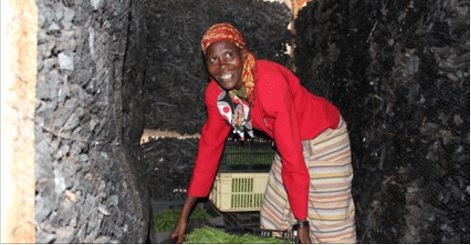 |
| This charcoal cooler room reduces the outside temperature from 30°C to 8°C http://www.nation.co.ke/business/seedsofgold/Our-charcoal-cooler-keeps-produce-fresh-/-/2301238/2397960/-/119pv5mz/-/index.html |
3 Look to the 3rd World people / underprivileged for idea's on how to cope in what will be, for you, "different" times but for them it is perfectly natural
i) For storing food long(er) term without adding additional strain on the system / environment, their innovative ways are amazing e.g. charcoal cooler rooms for storing harvests. Such a blooming simple idea, and it obviously works :) And is a damn sight cheaper than (electric) refrigeration...
ii) Learn to preserve your harvests via dehydration or canning - it's not difficult if you get yourself a reputable preserving book. And is oh, so gratifying, to use those preserves out of season. Plus you get the added benefit of knowing exactly what is in what you are eating and can be reassured that GMO and chemicals are not forming a hidden part of your or your family's nutritional intake.
iii) Investigate (a.k.a. Google lol) how they manage to grow crops in their adverse climates (both extremely hot and cold) and what measures they take to ensure that they are able to harvest something / anything...
Those are just a few thoughts I wanted to share with you and they are just a few of the steps that can be taken now that will benefit you in future.
I leave you with this:
http://www.forbes.com/sites/marshallshepherd/2016/07/02/lessons-from-jet-stream-crossing-the-equator-mania/#8535b905a8c3
P.P.S.
This is what the vandals did - this little action affected at least 350 - 500 people!
P.P.S.
This is what the vandals did - this little action affected at least 350 - 500 people!
 |
| The power junction box was ripped off the tower and the cables were disconnected. I took Escom 4 days to repair... :( |


