I don't drink anything with caffeine, so I drink loads and loads of Rooibos (redbush) (scientific name Aspalathus linearis) tea, as well as a glass or two of wine in an evening (and the grapes for that are already planted...)
I have decided to see if I can grow my own brew... One of the few places rooibos is grown is in the Cedarberg Mountains in the Western Cape. There they grow in very indifferent soil, in an area which has long, hot and dry summer periods, and the plants receive no irrigation. The winters - well, the Cedarberg is one of the places in South Africa where snow is generally a given in winter, so I know they can take the cold.
So I have been searching for rooibos plants for the farm, to no avail.
Thankfully though, I have managed to find some Rooibos seeds. Plants - forget! But seeds - there are loads of them available, even though each legume only produces one rooibos seed. They were pretty steeply priced at ZAR1.50 each (US$0.22) - I bought 20 - plus postage and packaging of ZAR70.00 (US$10.41) - thus that equates to ZAR5.00 / seed! Hope they are all viable...
 |
Rooibos plant
Image source:
http://www.bigtreehealth.com |
Only problem is they were supposed to be planted in March - reckon July is a tad too late. But, being impatient, I am going to try and plant a few and see what happens. What's the worst that can happen - they don't germinate? Having purchase 20 seeds I can (possibly) sacrifice 4 to the experiment.
 |
Rooibos farm
Image source:
http://www.kapstadt.org |
They require sandy soil - and will happily grow in nutrient poor conditions. So I will have to get a load of sand in (for my clay ground), dig some deep holes, fill them with the sand, adding just a bit of compost, and then plant my (hopefully) soon-to-be sprouting seedlings. Ah, that means another visit from the digger / loader - we've got lots we need him to do, so that will be good :-)
Rooibos is very beneficial for the body.
"It contains calcium, potassium, magnesium, iron, zinc and sodium, as well as trace elements - copper and manganese - as well as fluoride.
Rooibos is particularly rich in flavonoids, and laboratory studies have shown that the antioxidant activity of Rooibos is similar to that of black and green tea.
Rooibos has also been shown to slow down skin cancer, inhibit the development of liver cancer and combat cancer of the oesophagus. It is also recommended as a treatment for respiratory disease and helps protect against liver disease."(The above information is taken from: http://www.rooibosltd.co.za/research/index.html and http://www.rooibossa.co.za/fact-file.html)
It has quite a distinct flavour - a sort of slightly aromatic, sweetish sensation in the mouth and it produces a reddy-brown cup of tea, as opposed to the greyish colour of a ceylon brew. It is an acquired taste.
It can be enjoyed hot or cold, with milk and sugar, black with or without sugar, or black with a slice of lemon and honey to taste.
If this experiment should fail, then I will try and get hold of a few Honeybush plants (scientific name cyclopia genistoides, cyclopia subternata or cyclopia intermedia) which are grown in, and along, the coastal district near us. Guess it's always wiser to go with what is indigenous to your specific area...
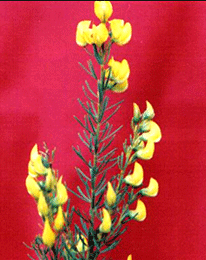 |
Cyclopia genistoides is found on sandy soils of the coastal areas from Yzerfontein near Darling on the West Coast, southwards to the Cape Peninsula and from there eastwards to Gouriqua close to the mouth of the Gouritz river. In the Cape Peninsula, however, this species is sometimes also found in mountainous areas Image source:
http://www.arc.agric.za |
Honeybush is also used to make tea - not quite as aromatic as Rooibos, but a healthy tea, none the less.
 |
Cyclopia subternata is found in milder micro-climatic conditions when compared to C. intermedia. It is found in relatively large numbers in the Tsitsikamma and in the Langkloof and in various localities on the southern slopes in the Outeniqua and Langeberg mountains. Image source:http://www.arc.agric.za |
 |
Cyclopia intermedia
is found over a wide area from near
Thornhill in the Eastern Cape westwards in
mountainous areas to at least near
Robertson in the Western Cape
Image source:
http://www.arc.agric.za |
Both the visual and the colours of these pea-like flowers on this honeybush plant strengthen my resolve to grow only useful plants in my garden.
Why waste precious resources (soil nutrients, water, etc) on purely ornamental plants? If one can also benefit nutritionally, then bring them on...!
For more information on the Honeybush please go to:
http://www.arc.agric.za/ or
http://www.plantzafrica.com/plantcd/cyclopiagenistoides.htm and http://www.capehoneybushtea.co.za/processing.htm
Now, all I have to sort out is RMan's coffee...


