"Self-sufficiency does not mean 'going back' to the acceptance of a lower standard of living. On the contrary, it is the striving for a higher standard of living, for food that is organically grown and good, for the good life in pleasant surroundings... and for the satisfaction that comes from doing difficult and intricate jobs well and successfully." John Seymour ~ Self Sufficiency 2003

Saturday, 9 July 2016

The latest addition to the family...

... arrived last Sunday.

RSon phoned RMan last Sunday morning.  He told him a story about a 3 - 4 year old animal at the apartment block where he lives in town, which had been left behind by his first owner.

How can anyone do that?

The new inhabitant of that apartment adopted the animal.  But, he was recently diagnosed with Leukemia.  They thought that the cancer had spread to his lungs because he was having difficulty breathing.  It turn out he was allergic to it.

Sigh.

So it went to another occupant - who already had a one, and the two didn't get on.  So the new owner made it sleep outside on the balcony / verandah at night.  On a cushion on their patio chair in the freezing cold!!

What???

Anyway, to get back to topic...

RSon wanted to know from RMan if we would take the animal.

Bloody hell, yes!

So RSon immediately hopped into his car and drove for 3 hours to bring her to us.

How can anyone be cruel to an defenseless, harmless animal?

So - introducing Snoopy...
Snoopy on the couch with RMan - RMan
 was still taking it slow whilst Snoops got
 to know us so minimal touches which she
flinched away from, and no sudden movements.
Who calls a cat Snoopy, who comes when she's whistled, and who doesn't meow, but makes tiny little squeaks lol

The poor traumatized thing hid under RSon's bed for 2 days!

We were very worried about her - nothing to eat, nothing to drink, no sandbox use even though I, concerned, put the food, water and box in the room with her...

Finally, on the third day she ventured out from under the bed - and room.

I brought everything downstairs to the kitchen again, and she has finally started eating, and drinking properly.

She is very skittish, and runs and hides at the slightest loud noise or sudden movement.

Yesterday our neighbour popped in for 10 minutes - and Snoopy disappeared.  I thought that perhaps she had taken fright and run out through one of the open doors.

We searched high, we searched low, down on hands and knees, and up on tip toes.  She was nowhere to be found.

I tried thinking like a cat - and checked in all the kitchen cupboard doors which had been open during the day.
Believe it or not, Snoopy squeezes into the space
 behind the records - all you can see from the outside
 is the tips of her two little ears sticking up
I checked in the small space behind the LP records we have in a shelf - where she had hidden before.
The tiny footwell under my writing
desk which I inherited from RMan's mom
I checked in the tiny footwell under the writing desk where my laptop is situated.

Nada!

Damn.  Where could she be.

Walking round outside, calling, psssss-ing and whistling (she comes to whistles?!?) and nothing.

Then I remembered that I had brought in the washing from the line.

Could she?

Is she?

Yup, she climbed in the bottom and RMan's cupboard and hid amongst his shirts.

Sigh.  What a relief.  She is safe.

She is s-l-o-w-l-y getting better, more friendly, and more exploratory.

It will just take time.
Snoopy on the front patio -
basking in the afternoon sun
Tomorrow she has been here for a week.  This afternoon, in celebration,  she ventured out onto our front patio.

She met the chickens.  And the rooster.

And was very intrigued.

From a distance.

As soon as they came up the front steps to investigate her, she scarpered indoors again, and watched them through the window.

Ditto, the alpacas fascinate her - from the window sill  lol

Snoop has decided that my lap,
 covered in my comfy gown, is
 an acceptable place to watch TV
  with us in the evening
There is just so much to explore here at her forever home...

Monday, 4 July 2016

Prepare yourselves...


...life is going to be very different on Mother Earth.  It would appear that we have passed the point of no return, and there is no going back.

This is seriously scary stuff...


'Unprecedented': Scientists Declare Global Climate Emergency After Jet Stream Crosses Equator

http://www.rawstory.com/2016/06/unprecedented-scientists-declare-global-climate-emergency-after-jet-stream-crosses-equator/
 or if you want to watch this on YouTube:
 
https://www.youtube.com/watch?v=CKasUm77D0U
Take the time to consider how this change in our weather / climate / jet stream is going to affect you, and how you, personally, can mitigate the changes to enable you to continue to grow your own produce and provide for yourselves.


I wrote this posting above before :

1) I lost my internet connection for 3 days due to vandalism
2) I discovered that there is no need to panic - jet streams moving from the northern to southern hemispere, and back are apparently "normal" (https://www.washingtonpost.com/news/capital-weather-gang/wp/2016/06/30/claim-that-jet-stream-crossing-equator-is-climate-emergency-is-utter-nonsense/

But, the original article does raise a point.  Actually, a couple of points.

Climate change, is, I believe, irrefutable, and with that in mind, the more steps we all take to prepare ourselves for the difficulties that lie ahead, the better off we will be to assist those in need / without knowledge when the time comes.  Standing back and waiting for someone else to solve our problems is the normal reaction.  But, being proactive, and starting the process for ourselves - and for our children - will stand us in better stead.

What can you do I hear some of you ask?

1)  Conserve water - don't take your access to water for granted, not even if you have a crystal clear stream passing through your property.

i)  Source (if necessary) and seriously apply mulch around your plants
ii)  Collect and store whatever rainwater falls in whichever way you can
iii)  Experiment with a simple hydroponic / aquaponic system - don't let the fear of the unknown stop you from investigating this food growing avenue. Experimenting now will allow you to become more "qualified" and able to use this method confidentially in the future.  (note - we have had to make an adjustment with our hydroponic experiment - more news coming up in a future posting).

2) Adapt

i) Be prepared to change the types of crops that you normally grow - for instance consider growing different crops that are suitable for the changing weather in your area
ii) Invest in shade netting / greenhouse tunnels to assist your plants in performing / providing to their maximum ability.
iii)  If there are crops that require a certain amount of rainfall, start researching similar alternatives which will provide you with those nutrients / carbohydrates / proteins now - don't wait until TSHTF.

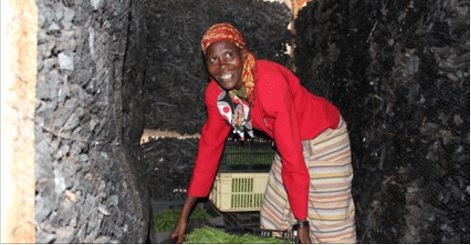
This charcoal cooler room reduces the outside
temperature from 30°C to 8°C
http://www.nation.co.ke/business/seedsofgold/Our-charcoal-cooler-keeps-produce-fresh-/-/2301238/2397960/-/119pv5mz/-/index.html


3 Look to the 3rd World people / underprivileged for idea's on how to cope in what will be, for you, "different" times but for them it is perfectly natural

i)  For storing food long(er) term without adding additional strain on the system / environment, their innovative ways are amazing e.g. charcoal cooler rooms for storing harvests.  Such a blooming simple idea, and it obviously works :)  And is a damn sight cheaper than (electric) refrigeration...
ii)  Learn to preserve your harvests via dehydration or canning - it's not difficult if you get yourself a reputable preserving book.  And is oh, so gratifying, to use those preserves out of season.  Plus you get the added benefit of knowing exactly what is in what you are eating and can be reassured that GMO and chemicals are not forming a hidden part of your or your family's nutritional intake.
iii)  Investigate (a.k.a. Google lol) how they manage to grow crops in their adverse climates (both extremely hot and cold) and what measures they take to ensure that they are able to harvest something / anything...

Those are just a few thoughts I wanted to share with you and they are just a few of the steps that can be taken now that will benefit you in future.

I leave you with this:


http://www.forbes.com/sites/marshallshepherd/2016/07/02/lessons-from-jet-stream-crossing-the-equator-mania/#8535b905a8c3

P.P.S.

This is what the vandals did - this little action affected at least 350 - 500 people!
The power junction box was ripped off
 the tower and the cables were
 disconnected.  I took Escom 4 days
to repair... :(

Saturday, 25 June 2016

Feathers of a different kind...

RMan was walking outside when his sharp eagle eyes spotted a couple of these feathers lying on the ground.
A feather from the Cape Parrot?
Whaaaaaaat???

I have never seen a bird with these colours / markings here where we live.
The Cape Parrot is the one in the lower
 right hand corner
Consulting my Robert Birds of Southern Africa book, the only bird I can possibly identify it with is a Cape Parrot.  But, again, I have never heard anyone mention it...
The distribution map shows that although it's
 name Cape Parrot, it does not frequent this
  part of South Africa...
A Cape Parrot - which is not normally found in the (Western or any) Cape??

But there is no other bird in the book which comes even close to those markings / colour.

Naturally, I am keeping my eyes peeled for a repeat visit so that I can confirm the sighting.

But, if any of my readers can help me confirm / re-identify which bird these feathers belong to I would be very grateful.

~

We have been having a plethora of absolutely breath taking sunrises and sunsets - and I have to share these pics I took of the sunrise from the 20th June.
Skies such as this mesmerise me. 
The colours lingered for such a long time -
 almost right up until the sun rose above the
 horizon
And make me realize how starved I was for both whilst we were living in our town house in the valley.  Surrounded on both sides by mountains, view such as this weren't possible.

They provide such an incredible way to start (or end) the day... :D

Tuesday, 21 June 2016

Chicken feeder

I think I now know why our first rooster was so 'ornery'.  Our second rooster has been trying to 'attack' RMan - who defends himself with a well aimed kick with a sturdy boot, which has never made contact, but certainly shoo's the bird away.
I tried to wait until the last moment in the day
to feed the wild birds, but even then the chickens
were coming back to see what they could scrounge
before they hit the coop for the night.
The blooming chickens seem to be perpetually ravenous - even to the point of chasing the wild birds away so that they can eat the food which I throw for them every evening.

Perhaps the rooster and chickens aren't getting enough and they are hungry, I thought?  It doesn't seem logical, because they are 100% unrestrictedly free-ranging as well as being given a small amount of breakfast (a mixture of corn pieces, pearl barley, sunflower seeds, red lentils and laying pellets) when they are released from the coop in the morning, and a slightly larger amount for dinner before they are safely ensconced in their coop for the night.

So I decided to research chicken feeders that I could leave in the coop for them to help themselves to whenever they felt like it, but that wouldn't also feed / encourage the field mice.

I have seen various chicken feeders floating around blogosphere.  And all, except the 'stand on and open lid" one, seemed to be vulnerable to feeding the local rodent population.

And then I saw one that seriously appealed to me.

So, with RMan's help we set about sorting it up.

It entails a thoroughly cleaned, recycled 25lt bucket (left over from when we painted the house) and two drain pipe corners.
I tend to fill up the bucket so that the tops of the
drainpipe corners are covered.  That amount of food
 lasts the chickens for a week - in addition to their
 free ranging all day long.
After cutting a suitably sized hole in the paint bucket, the drain pipe corners were placed facing down in the new openings, leaving a 2.5 - 3.0 cm space between the base of the paint bucket and the lowest point of the drain pipe corner, and they were then siliconed into place.  That 2 - 3 cm gap will allow the food to continuously fall within reach of the internal drain pipe corner opening / chickens hungry mouths.
As I filled the feeder bucket for the first time,
 and before I had chance to place it in their
 coop, they all crowded round.  Munching took
place in the normal pecking order.
The bucket was then suspended from the roof and placed on two bricks to give it "pecking stability" - I didn't want any overly eager chickens knocking another one out with a swinging bucket lol.  Within 15 minutes of placing the new 24 / 7 feeder in place, the chickens were already inspecting it / filling their stomachs.
The one chick couldn't wait to get it's
head into the feed bucket.  Shoving
their heads relatively deep inside the bucket

 doesn't seem to bother them at all.
The bricks / height also ensure that the
 field mice can't access the bucket nor
 it's contents.
The beauty if this system is that the chicken heads are so far inside the bucket that they don't make any mess whatsoever.  So, there is no attracting rodents to munch on the mess and take up residence in the chicken coop :)
The bricks are under the bucket for stability
 and do not provide easy access for rodents to
 get to the food - too high for them to jump
 without having a non-slippery surface to
 land on.  Plus, they cannot access the food
 from the top either - again, too slippery :)
Serendipitously, the rooster has lost his aggression...! :)

How much additional food are they consuming?  Over a week it is roughly twice the amount that I used to feed them in a single day - i.e. 8 days worth of food over 7 days.  So, no great increase in feed costs, and, by way of thank you, all five of the chickens are now laying :D

Friday, 10 June 2016

Bats aren't in the belfry


At the beginning of May I was standing at this window watching RMan who waas busy with the alpacas in the paddock and noticed what I thought was a piece of wind blown litter in this little bush...
This is our east facing bedroom window (so
 that we can lie in ed and watch the sunrise -
 which we've never done lol)
...Irritating.

So, I had to go and remove it.  That's me - OCD.
Can't remember what this bush is called
 but it came with us from our town house -
 t'was a self-seeded baby from the mother
plant
Giving it a good squizz before attempting to remove it, I discovered...
On closer inspection "that" doesn't look like
a piece of litter.
... that it wasn't litter, it was in fact a bat!
That because "it" is a bat!
Out of the belfry!!

I wasn't going to touch it to find out if it was still alive - which it obviously was, because it wasn't there the next day.

I've never heard of bats that don't hide themselves away in the dark during the daylight hours, especially given that this is an east facing wall and it, the bush and the bat would've been in the sun all morning.

Weird! 

Saturday, 4 June 2016

Drying laundry in winter

I haven't used a tumble dryer in absolutely yonks.  Don't even own one.  If the weather isn't clement enough to wash and hang up laundry, I wait until it is.

Our washing line is situated in our back yard close to the washing machine for ease of hanging up, and close to the house for ease of removing from the line.  But that has it's drawbacks.
My winter shaded twirl dry
As you can see from the pic above in winter the sun doesn't reach the washing line.

That's where the beauty of  blogging comes to the fore.

Diana's garden arbour
A while ago, Diana, from Elephants Eye was contemplating what kind of washing line she should install in their new house.  She had received inspiration from another blogger, and this is what Diana erected - a laundry drying arbour.

Yeeeees!!

That gave me an idea :)

Our garage looks like many people's I'm sure.  Plenty big enough, but a wonderful depository for all things non-vehicle.
The new carport - positioned in front of the
shadecloth covered veggie patch
Which meant that my car was standing out in the hot sun in summer.

So, I suggested to RMan that we add a shadecloth covered carport to our property.
It is still close enough to the house to
collect the washing if an unexpected clouodburst
happens by...
The placement of the structure has a two fold application.

Firstly, as a carport lol

But, secondly, it will protect my piquanté pepper plants from frost.

We have positioned it a couple of meters to the north of the shadecloth veggie patch.
Perfect - the old twirl dry is in the  background
 
in the shade , and the new washing carport lines
 are in 
the sun.
As you can see from the pic above, the old twirling washing line is in the shade, but the northern sides of the new carport are perfect for hanging those thicker items which take longer to dry.  There are two horizontal lines - which prevent the longer items from blowing against the car, and also they provide me with twice as much hanging space.

Damp washing is a thing of the past :)

Not as pretty as Diana's - but, thanks for the idea Diana :)

When there is no washing on the new lines you can't even see the extra hidden purpose of this carport.

Wednesday, 25 May 2016

Winter joy

"To everything, turn, turn turn,
There is a season, turn, turn, turn..."
Early morning mists which settle into the stream
 / river valleys
You have to have contrast.  I am not a member of the "I hate winter" club.  Rather, I relish the cooler weather.  I am more mentally alert, more physically active, and more inspired in the kitchen.

Here are some of my favourite things that I love most about winter...
Sunrises...
... and sunsets
Brooding, inspiring, breath-taking sunrises and sunsets.

A wood burning fire - which not only heats our entire home, but also gives me access to an oven in which I can bake...
My darling Rosie
...roasted homegrown vegetables, homemade pies and samosas, bread, lasagnas and pizza.
4 ingredient mealie bread - the smell fills the air,
 and the taste is heavenly :)
(recipe here)
Homemade chicken or creamed spinach samosas
 in phyllo pastry (recipe here)
Lasagne, pies, samosas and pizza can't be cooked on top of our two plate gas stove, nor will the latter three be successful in my solar oven, so we go without / my menu options don't include those during the summer months. 
Rain - glorious rain.
I remember it well, and wait in anticipation
of it falling again...
Rain - filling our rain water tanks and earthen dam, refreshing the garden and cause the land around us to go green - as opposed to the dried out, brown appearance during summer :)
Long and short gumboots - for
use when it pelting down with rain which
forms muddy puddles everywhere, or
 when  there is just damp grass
Gumboots (long and short) to keep my feet dry, chunky jerseys and a down jacket against the cold outside air, and a warm bed to sleep in.  I am aware of all those who aren't as fortunate, and know that I'll never take those luxuries for granted.
Two and a half dehydrated pumpkins fit into
2 X 1 lt jars
Eating summer out-of-season home grown produce - which has either been canned or has been dehydrated in my new Foothills DryAway ;)


Homemade jams and beetroot...
  ...and tomato puree / concentrate
Dehydrated herbs and vegetables (which at this stage only
 include pumpkins and piquanté peppers)
Lying in bed in the morning, cup of rooibos tea (for me) or coffee (for RMan) in hand, looking at the snow capped mountains in the distance.
Snow capped mountains in the distance
  Aaaah!  What's not to love about winter...?  :D

Friday, 20 May 2016

Hydroponics vs ground 1

Following my posting on the basic hydroponic system we set up, I thought I'd give you all an update.

But first, I omitted to share with you the analysis of the alpaca poo we had done.


Alapaca poo analysis
The gentleman we saw told us that the alpaca poo results were fantastic.  Even asked us if we want to market it lol  Perhaps if we had 50 alpacas, but with only 4 - they just don't poo enough to make it viable...
Results of grape waste (pomace) analysis
For comparison, I am also giving the sample results of grape waste that he gave us.  As you can see, the alpaca poo is far more nutrient rich than the grape waste.

Of the various experiments I am trying out, I planted some cabbage seedlings in the gravity fed hydroponic system, and some in the ground below the hydroponics.  [One of my brothers reckons that cabbage needs a firm footing (in the ground) and he is doubtful that growing them hydroponically will work.  I'm not looking to grow champion sized cabbages, so let's see ;) ]

But, and for update on the cabbages I planted only three weeks ago:

This is the cabbage in the ground.  Not much change there, is there.  They were planted with some additional alpaca poo.
The control "ground planted" cabbage -
 not much change from when it was planted
 out from the seedling tray
And the hydroponic one...
The hydroponically growing cabbage - almost
double the size and far sturdier looking
 leaves and plant, and more abundant growth
As you can see there is quite a substantial change.

Water catchment tank specifications
The only feeding that the hydroponic system gets is some Seagrow (seaweed extract) and a knee high stocking which has been half filled with ground alpaca poo, and which is suspended in the receiving tank so that the nutrients can leach out into the water as it fills the tank.

Very encouraging.

I will update as the two plants progress - until one of them reaches cabbage head stage... :)