"Self-sufficiency does not mean 'going back' to the acceptance of a lower standard of living. On the contrary, it is the striving for a higher standard of living, for food that is organically grown and good, for the good life in pleasant surroundings... and for the satisfaction that comes from doing difficult and intricate jobs well and successfully." John Seymour ~ Self Sufficiency 2003

Tuesday, 12 July 2011

Time out (side)

It's been a difficult couple of weeks recently - my camera decided to go on the fritz, even my cell phone felt lonely and did likewise, so with both out of commission I have been unable to take any photo's - talk about feeling marooned...  Add to that the fact that just I've developed another bout of bronchitis (it's only three months since my last bout - and twice in one winter - what is gong on - too much international air travel spreading new infections to all in sundry?)


I think you get the picture...


However, I remedied the photo problem this last weekend, buying myself a cheapish Kodak - it'll do until I can get my Canon fixed, and that entails a trip across to the other side of town.
We are currently experiencing a "berg wind" (a hot, off-land wind) in our area - a welcome break from the cold, wet and miserable weather we've been having recently, and I figured it was the perfect time to wash all those towels and jerseys LOL  And the perfect opportunity to get out into the garden...


The garden has patches of colour - the lemon tree is full of fruit, the hibiscus trees are displaying their exotic flowers, the Camellia bush is about to burst into bloom, and the lavender bushes are in full swing.
Broad beans in flower
Even my broad beans are full of flowers... but I've only found 6 pods! Very disappointing.  But I think I have discovered the reason why:
The bees are all on the lavender bushes...


Wrong, wrong, wrong side of the garden, guys!  I need you to do your thing on the broad beans!


I have managed to harvest a few things from the garden though:
Lavender flowers, lemons and clivia pods
The lavender flowers are in the spare room - acting as a room freshener...
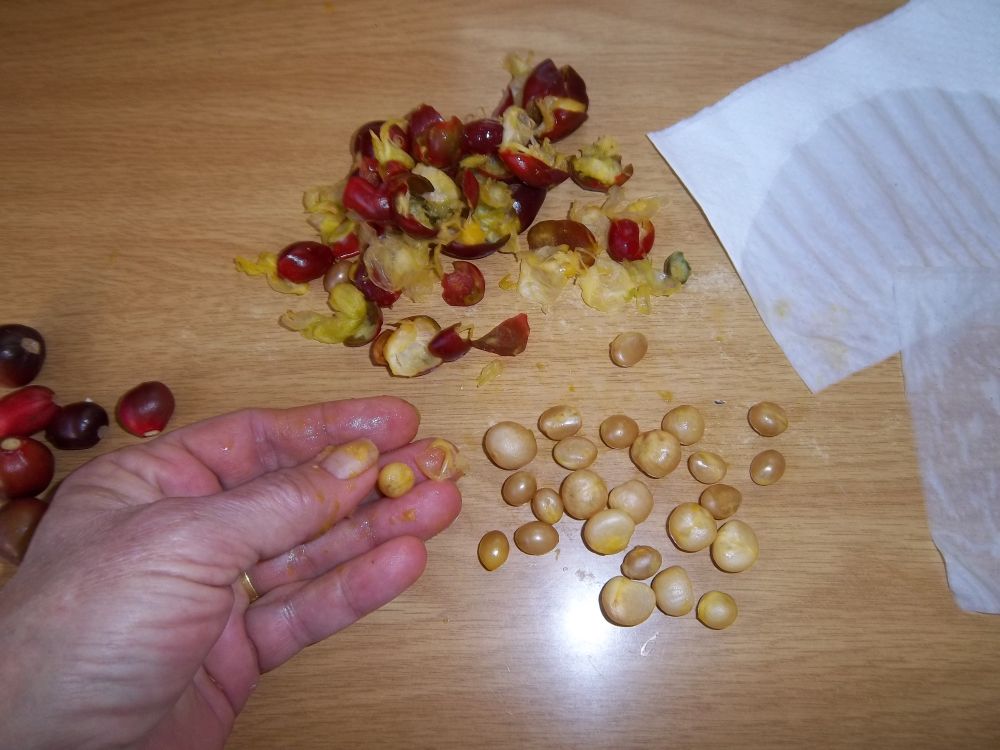
The red Clivia pods are free plants waiting to happen.  And all it takes is a bit of preparation.
Firstly, remove the hard outer shell of the pod.  Inside that you'll find another, softer sheath around the seed - remove that as well:
Place the seeds between a couple of pieces of damp kitchen paper towel:
...and tie them up in a plastic bag...
 ... leave the bag in a dark-ish spot for about a month, until you see the seeds starting to produce shoots - and then plant the seeds in a seed tray, until they are big enough to transplant into the garden.
Then all it takes is patience - about three years worth LOL  The reward?


A magnificent show once a year!
Clivias love to be positioned in dappled shade, so providing you can provide that, they will reward you with colour in a darker part of your garden.  They are not terribly fussy about requiring lots of water - a sprinkling once a week is all that they need.


If anyone has any seed pods from pale apricot, or yellow clivia plants they don't want, I'd love them - please :)


What did I do with the lemons?


You'll have to wait until next time to find out...! :)

Friday, 8 July 2011

Do animals have (human) feelings...?

I am a big fan of Cesar Millan - the dog whisperer.


And I understand when he says don't try and make a human out of a dog.  Rather give it structure, balance and guidance - the same treatment it would receive in a pack.


But I wonder - do dogs (and other animals) have feelings - human feelings?  Do they love, hate, cry, mourn, delight, sulk and possibly hold a grudge?


And can they understand (human) language?
Perhaps we should be careful what we say around animals... just in case they can understand us :-)


Dogs are, after all, man's best friend - I know I've had at least 3 canine best friends in my life.  And I am richer for having known them.  I hope they felt the same.

Thursday, 7 July 2011

Solar irradiation map

Definition of solar irradiation : rays which are emitted by the Sun. (www.science-dictionary.com/definition/solar-irradiation.html)


If you've ever wondered how effective a solar oven would be in your area, there is now global map available on-line.


This is the map for Southern Africa:
For other Global maps please go to: http://solargis.info/doc/71
The maps of Global horizontal irradiation (average sum 2004-2010) for Africa and Europe are available to download here. SolarGIS database is the source of solar data represented on the maps.

The maps are free for public use, their reproduction and adaptation is authorised provided the following source is acknowledged:  
SolarGIS © 2011 GeoModel Solar s.r.o.


At the moment SolarGIS don't seem to have maps for the US of A, Asia or Australia/ New Zealand - perhaps you could contact them to query?  (They are based in Slovakia.)


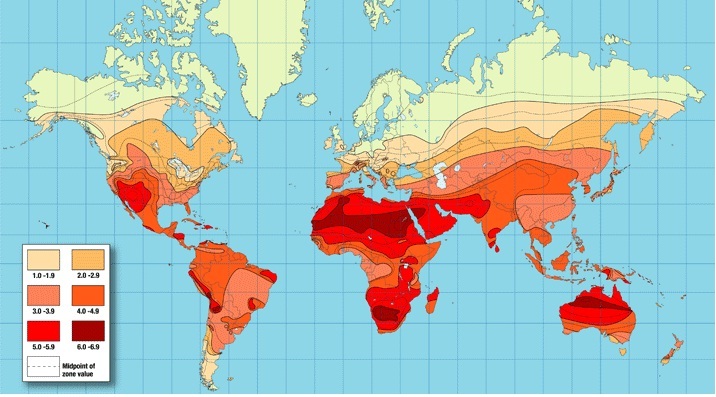
Alternatively, from this site I found this map:
World Daily Solar Insolation Map.
This map shows the amount of solar energy
in hours, received each day on an optimally
tilted surface during the worst month of the year.
But, to give you an idea of what the first map means - we are in a 1700 - 1900 kWh/m2 area (on the second map we are in the 4.0 - 4.9 or Zone 2 range) and I have no problem reaching temperatures of 200°C (400°F) in my solar oven in summer.  Unfortunately, I am unable to give you temperatures in winter as our (town) garden only receives approximately 1½ - 2 hours of sun - right at the bottom of our garden.


On the farm - I don't know at the moment, but I should be able to tell you by the 20th July - RMan shares his birthday with Mr Mandela, and he (RMan, that is) has decided that he'd like to spend it on the farm :-)  Although Mr Mandela is very welcome too...


So, if all goes according to plan, I will be schlepping the solar oven along.  Reckon it will be a very interesting experiment.  Discovering just how much I can use the solar oven in winter will be a b-i-g plus for our off grid life...

Tuesday, 5 July 2011

Just a bit of fun...

Take a visit to this site and see what the effects of a 2 - 60.0 mtr sea level rise would mean for you.


http://www.quickprofiler.com/Sea_Level_Rise_Map/default.aspx
At 20.0 mtrs Table Mountain and most of the Southern Suburbs of Cape Town would become an island.


At the maximum of a 60.0 mtr rise the only place we'd be O.K. would be on the farm.


Makes you think, doesn't it...?!

Saturday, 2 July 2011

Moving further towards self-sufficiency

I don't drink anything with caffeine, so I drink loads and loads of Rooibos (redbush) (scientific name Aspalathus linearis) tea, as well as a glass or two of wine in an evening (and the grapes for that are already planted...)


I have decided to see if I can grow my own brew...  One of the few places rooibos is grown is in the Cedarberg Mountains in the Western Cape.  There they grow in very indifferent soil, in an area which has long, hot and dry summer periods, and the plants receive no irrigation.  The winters - well, the Cedarberg is one of the places in South Africa where snow is generally a given in winter, so I know they can take the cold.


So I have been searching for rooibos plants for the farm, to no avail.


Thankfully though, I have managed to find some Rooibos seeds. Plants - forget!  But seeds - there are loads of them available, even though each legume only produces one rooibos seed.  They were pretty steeply priced at ZAR1.50 each (US$0.22) - I bought 20 - plus postage and packaging of ZAR70.00 (US$10.41) - thus that equates to ZAR5.00 / seed!  Hope they are all viable...
Rooibos plant
Image source:
http://www.bigtreehealth.com
Only problem is they were supposed to be planted in March - reckon July is a tad too late.  But, being impatient, I am going to try and plant a few and see what happens.  What's the worst that can happen - they don't germinate?  Having purchase 20 seeds I can (possibly) sacrifice 4 to the experiment.
Rooibos farm
Image source:
http://www.kapstadt.org
They require sandy soil - and will happily grow in nutrient poor conditions.  So I will have to get a load of sand in (for my clay ground), dig some deep holes, fill them with the sand, adding just a bit of compost, and then plant my (hopefully) soon-to-be sprouting seedlings.  Ah, that means another visit from the digger / loader - we've got lots we need him to do, so that will be good :-)


Rooibos is very beneficial for the body.


"It contains calcium, potassium, magnesium, iron, zinc and sodium, as well as trace elements - copper and manganese - as well as fluoride.


Rooibos is particularly rich in flavonoids, and laboratory studies have shown that the antioxidant activity of Rooibos is similar to that of black and green tea.

Rooibos has also been shown to slow down skin cancer, inhibit the development of liver cancer and combat cancer of the oesophagus.  It is also recommended as a treatment for respiratory disease and helps protect against liver disease."
(The above information is taken from: http://www.rooibosltd.co.za/research/index.html and http://www.rooibossa.co.za/fact-file.html)


It has quite a distinct flavour - a sort of slightly aromatic, sweetish sensation in the mouth and it produces a reddy-brown cup of tea, as opposed to the greyish colour of a ceylon brew.  It is an acquired taste.


It can be enjoyed hot or cold, with milk and sugar, black with or without sugar, or black with a slice of lemon and honey to taste.


If this experiment should fail, then I will try and get hold of a few Honeybush plants (scientific name cyclopia genistoides, cyclopia subternata or cyclopia intermedia) which are grown in, and along, the coastal district near us.  Guess it's always wiser to go with what is indigenous to your specific area...
Cyclopia genistoides
is found on sandy soils of the coastal areas from
Yzerfontein near Darling on the West Coast,
southwards to the Cape Peninsula and
from there eastwards to Gouriqua close to the 
mouth of the Gouritz river.  In the Cape Peninsula,
however, this species is sometimes also
found in mountainous areas
Image source:
http://www.arc.agric.za
Honeybush is also used to make tea - not quite as aromatic as Rooibos, but a healthy tea, none the less.

Cyclopia subternata
is found in milder micro-climatic conditions
when compared to C. intermedia.  It is found
in relatively large numbers in the Tsitsikamma
and in the Langkloof and in various localities
on the southern slopes in the Outeniqua
and Langeberg mountains.
Image source:http://www.arc.agric.za

Cyclopia intermedia
is found over a wide area from near
Thornhill in the Eastern Cape westwards in
mountainous areas to at least near
Robertson in the Western Cape
Image source:
http://www.arc.agric.za
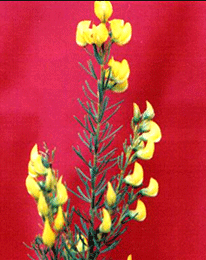
Both the visual and the colours of these pea-like flowers on this honeybush plant strengthen my resolve to grow only useful plants in my garden.


Why waste precious resources (soil nutrients, water, etc) on purely ornamental plants?  If one can also benefit nutritionally, then bring them on...!


For more information on the Honeybush please go to:


http://www.arc.agric.za/ or
http://www.plantzafrica.com/plantcd/cyclopiagenistoides.htm and http://www.capehoneybushtea.co.za/processing.htm 


Now, all I have to sort out is RMan's coffee...

Friday, 1 July 2011

Preparation...?

How do you feel about even contemplating the possibility of a worst case scenario? Be that a natural disaster, a cataclysmic event or an unforseen family / personal calamity. 


How do you feel about preparing for worst case scenario's?


We are all aware of the state of the worlds' economy.  And, I think by now, we are all aware than this situation is going to linger - longer.


So - I'm wondering how you are all fairing?  Do you have stock of dry goods?  Do you have stock of tinned goods?  Are they helping you to get through the current tough times?


Are you, in the Northern hemisphere, preparing to preserve your surplus from your vegetable gardens in the weeks / months ahead?


Have you ever preserved before?  I know I hadn't - until last season. But, LOL, Lynda Brown was all the impetus I needed.
I loved the experience - and the stock in my pantry at the end of the season.


Each container of goods, be they dry, tinned or bottled, that you have in your home / pantry, will help you through your tough times.


I am a firm believer in stocking up, whenever possible and /or affordable.  So I am always on the lookout for reduced prices in those "long life" items.  But I also ensure that the "sell-by-date" on those items is sufficient for me to happily make use of them in the future. Not that dry goods can "turn" - guess the worst that can happen is the infestation of weevils.  (For that, try adding a sprig of bay leaves to your container - and refresh the sprig every few months.)
Re-using empty plastic jars to store some
of my bulk dry goods
I should have been a Brownie, or a Girl Guide - isn't their motto: "Be Prepared"?  Or is that the motto of Cubs / Boy Scouts?  Whatever.  My parents couldn't afford for me to belong to either club when I was a child - little did they know that I would absorb important information from those who did.


Or is it my Scottish / English heritage which has reared it's head as I grew older?  I don't know.  All I do know is that I am forever squirreling away whatever I can, for a "just in case" scenario.


It's the same with a bar of chocolate.  If I have a bar of chocolate I will eat a few pieces, and put the rest away for another day, when I can enjoy it all over again.  I "stretch out" my enjoyment, as opposed to fulfilling a "gotta have it all now" lifestyle.


Guess that could be the key to "having" when the times get tough.  Leaving some of what you have for another day.  Don't just live for today - spare tomorrow a thought too.


I fear for the youngsters of today, for they seem, in general, to be, a "gotta have it - now!" generation.  Especially when it comes to the latest technology / gadget / designer label item.  I wonder, in fact, how many of them even contemplate tomorrow?  And I wonder if they ever give any thought what their basic requirements may be tomorrow...?


If they have grown up in a household where bulk storage / home preserving takes place, then they will be better equipped / prepared that their peers.  Purely through example.  Nobody is too old to learn.  Look at me - I'm a prime example. LOL 
My first attempt at home preserving -
pears, jam and pickled vegetables :-)
If like me, you get to preserving a little later in life, the lesson will still be taken on board by your younger generation - especially if they can eat / taste the benefit of your hard work.


So, if you're not buying dry goods in bulk when they are on special - try it.  It's very comforting to have that back-up when times are tough.


It is also encouraging when you realize that, through generating your own stores, you are:


1 invariably re-using your glass jars - or only having to replace their lids;
2 saving on using unnecessary fuel / reducing the amount of CO2 being expelled into the atmosphere, because you're not rushing to the local store whenever you run out;
3 reducing what goes to endless (or are they??) landfill sites;
4 enjoying the fruits of your labours :-)
5 And, finally, if you have a solar oven, you can preserve your produce without using any power from the grid...


You gotta love it... :-)

Wednesday, 29 June 2011

Over Wintering...

Seems I've come to an over wintering point...


Mr camera is broken.  My mobile, which I was having to use to take photo's, is frozen / broken, the skies are filled with black, heavy clouds and outside it is cold and miserable, and we can't find a moment to get to the farm...


However, to be grateful whilst I'm complaining, our home is warm and protected from the inclement weather, we have food on the table, and I can read about all the summer warmth and progress on others' blogs :-)


And have I ever found some brilliant idea's out there...


...more uses for those damn plastic bottles...
Image source:http://www.insideurbangreen.org/2010/03/
simpletomake-green-tote-box-sip.html 
This is called a SIP - a sub-irrigated planter.


I am fascinated with "wicking" / SIP type planters and have no idea what is attracting me to them.  But I think they are extremely clever.


What also fascinates me is the fact that apparently the yield in a wicking / SIP planter is noticeably more than in a conventional in-ground bed.  I believe that they have their place in any garden, no matter how small or large.  Certainly our 2 Ha farm has more than enough space to grow what we want, but we are hoping to plant it up with mainly fruit producing trees.  One of the reasons we are going to be doing that is because trees, even fruit trees, absorb carbon dioxide from the atmosphere.  And any assistance this planet can get in that regard is a must in my book!
Recycled bath

I will be having a shade cloth vegetable patch on the farm - as large as I can make it, for the summers there are wickedly hot.  This will house raised beds, straw bale beds - whilst outside it I will have wicking and SIP planters for those plants which need the benefit of all the bees :-)
This experimental one that RMan made me worked a treat :-)
The plants on the southern side of the vegetable patch will need some protection from the incessant summer wind.  I am visualizing a large "barn sized" vegetable patch, of at least 9 mtrs long by 3½ - 4 mtrs wide - big enough for at least three horizontal beds with paths in between.  That should give me approximately 27 running mtrs for vegetable production - which should produce more than enough food for RMan and I, and still have some left over to barter with / gift :-)


But, my herbs will be planted in wicking / SIP planters close to the kitchen door.  I'm trying to convince RMan that we can (and should) take our recycled bath with us - not sure if I'm going to win this one because he's not mad about the sight / thought of it, even though I have told him I can disguise it better...


Another great site I came across in May this year is this one.  Grant and Max Buster are two young brothers who are applying their brains to assisting the starving millions with their ideas.  There is hope for this planet if youngster like this are in the next generation.

Raised beds (Image source:
http://www.instructables.com/id/Natural-Wood-Raised-Garden/ )
The beauty of all the above systems is the fact that there are a zillion plastic buckets out there, especially food grade one's at restaurants / take away outlets.  When they buy their supplies in bulk, a lot of their consumables are supplied in buckets, and there are just so many buckets they can re-use.  So there will never be a shortage of plastic buckets to go round, all you have to do is become friendly with your closest restaurant / take away and do your bit for recycling...
Straw bale beds (Image source:
http://www.growandmake.com/straw_bale_garden )
And the final benefit of this type of growing container is the water preservation - we all need to conserve our water and use it as sparingly as possible.  I have been fascinated to read in the past couple of years that England goes through periods of drought - England??!!  My country of roots has droughts?  Hard to believe, but it's true.


If England is experiencing droughts, what does that say about South Africa's worsening situation in the years to come?  Help Mother Nature, and she's sure to reward us - but it will take a concerted effort from us all.


Linking the wicking / SIP planters to our irrigation system will ensure that the water will go where it is intended - to the roots of the plants and not to the surface of the soil where it will evaporate.


Itchy - damn so itchy.  I want to get going...  So much to do, so little time.  And patience is not one of my virtues.


Does anyone have any other sites which could provide further inspiration?


Aside:  As I was typing this I received the following message from TUT (Totally Unique Thoughts).  And I thought this mornings message from TUT was particularly apt :-)


"Some will hear, but not listen.
Some will listen, but not understand.
And some will understand, but not act."


I hope someone - anyone - a single person - out there understands what I am trying to do / doing and is influenced by our journey to the extent that they make a change in their life.  Change happens one person at a time...  And "thoughts become things" LOL

Monday, 27 June 2011

Solar recipe book - take 2...

Okey dokey - have signed up with a new bank, got all the gumpf from PayPal, sorted out all the hiccups, so here we go...

Solar baked biscuits
You can now purchase the solar recipes through PayPal LOL
Solar baked beans
Happy days...
Solar baked fruit cake
To purchase please go here.