"Self-sufficiency does not mean 'going back' to the acceptance of a lower standard of living. On the contrary, it is the striving for a higher standard of living, for food that is organically grown and good, for the good life in pleasant surroundings... and for the satisfaction that comes from doing difficult and intricate jobs well and successfully." John Seymour ~ Self Sufficiency 2003
Showing posts with label preserving. Show all posts

Sunday, 19 February 2017

AWOL and thanks for the nekkid dancing...

My apologies for being AWOL - did anyone miss me??  ðŸ˜‚

Things have been pretty hectic here - not only with the business, and some community issues, but also with harvesting.

My main crop every year is tomatoes.  Not necessarily to eat only fresh, but I grow as many as possible to preserve.
 Yellow heirloom tomatoes - in all their magnificent glory :D

There is nothing nicer than adding home made tomato puree and tomato concentrate to all those winter dishes - the privilege of last years harvest dances over my tongue with every mouthful.
The golden yellow heirloom tomatoes are generally
 great big brutes - just the way I like 'em ;)
My favourite tomato is a golden yellow heirloom...
I simmer the tomato mixture until it is good and thick
...as it makes the most gorgeous, golden-red tomato concentrate.
Tomato concentrate in recycled plastic tubs all ready to go into
 the freezer.  Those tubes are re-used, and re-used until they fall
 apart - and only then are they sent for recycling
Apart from water-bathing jars of concentrate, I also shove 125gm tubs of it into the freezer.  I find making bottled whole tomatoes a waste of time because when they are decanted, as we don't eat that many pizza's, they are mainly only suitable for "blitzing" into a sauce anyway.
Spiralized butternut dehydrating in the Foothills DryAway
I've also had fun spiralizing home-grown organic butternut and dehydrating it in the Foothills DryAway.
This is precisely why I made the middle shelf in the Foothills
 DryAway.  So that any food that dropped through the drying
  net could easily be retrieved.
When the butternut spirals are dry they resemble butternut tagliatelli 😃  Storing that in a preserving jar in the larder frees up freezer space for my tomato concentrate lol

To get to my "thanks for dancing nekkid" bit in the title of this blog post - kymber and Jam kindly performed a nekkid rain dance all the way across the planet in Framboise, Canada.

kymber - thank you my friend - it worked 😂

Four days later we had 40mm of rain... 
Oh - we waited so long for this sight...
Even the alpacas enjoyed the shower
...glorious rain.


It was enough of a sudden downpour to fill our dam by a third.
40mm of rain filled the dam by a third...
Although the water didn't last too long as the dried out shell quickly absorbed most of it resulting in the dam being almost empty again, it's also not surprising given the heat we've recently been experiencing.
...and caused the grass / grazing to turn a welcome
 greener colour
At least the rain caused the "grass" turned a little greener than dried out brown and is showing some sign of growth - especially in the alpaca paddocks. ðŸ˜Š

kymber and Jam - please, feel free to continue dancing nekkid - we need much, much more to come even halfway close to last's years rainfall...


For more info on how you can obtain your own Foothills DryAway solar / wind food dehydrator please click the link.

Sunday, 11 September 2016

Plum tree leaf problems


For the last couple of years my plum tree leaves have been quite off - to say the least.
Can anyone tell me why they are distorting like this,..
...and how do I treat it / hep the trees?

I have tried picking off the affected leaves (l-o-n-g job) and burning them, and thought that last year I had sorted out the problem, but obviously not.

It didn't seem to affect the harvest last summer, but it is obviously not right.


Marlin:
Larger res pics - absolutely no sign of aphids...?!


Monday, 4 July 2016

Prepare yourselves...


...life is going to be very different on Mother Earth.  It would appear that we have passed the point of no return, and there is no going back.

This is seriously scary stuff...


'Unprecedented': Scientists Declare Global Climate Emergency After Jet Stream Crosses Equator

http://www.rawstory.com/2016/06/unprecedented-scientists-declare-global-climate-emergency-after-jet-stream-crosses-equator/
 or if you want to watch this on YouTube:
 
https://www.youtube.com/watch?v=CKasUm77D0U
Take the time to consider how this change in our weather / climate / jet stream is going to affect you, and how you, personally, can mitigate the changes to enable you to continue to grow your own produce and provide for yourselves.


I wrote this posting above before :

1) I lost my internet connection for 3 days due to vandalism
2) I discovered that there is no need to panic - jet streams moving from the northern to southern hemispere, and back are apparently "normal" (https://www.washingtonpost.com/news/capital-weather-gang/wp/2016/06/30/claim-that-jet-stream-crossing-equator-is-climate-emergency-is-utter-nonsense/

But, the original article does raise a point.  Actually, a couple of points.

Climate change, is, I believe, irrefutable, and with that in mind, the more steps we all take to prepare ourselves for the difficulties that lie ahead, the better off we will be to assist those in need / without knowledge when the time comes.  Standing back and waiting for someone else to solve our problems is the normal reaction.  But, being proactive, and starting the process for ourselves - and for our children - will stand us in better stead.

What can you do I hear some of you ask?

1)  Conserve water - don't take your access to water for granted, not even if you have a crystal clear stream passing through your property.

i)  Source (if necessary) and seriously apply mulch around your plants
ii)  Collect and store whatever rainwater falls in whichever way you can
iii)  Experiment with a simple hydroponic / aquaponic system - don't let the fear of the unknown stop you from investigating this food growing avenue. Experimenting now will allow you to become more "qualified" and able to use this method confidentially in the future.  (note - we have had to make an adjustment with our hydroponic experiment - more news coming up in a future posting).

2) Adapt

i) Be prepared to change the types of crops that you normally grow - for instance consider growing different crops that are suitable for the changing weather in your area
ii) Invest in shade netting / greenhouse tunnels to assist your plants in performing / providing to their maximum ability.
iii)  If there are crops that require a certain amount of rainfall, start researching similar alternatives which will provide you with those nutrients / carbohydrates / proteins now - don't wait until TSHTF.

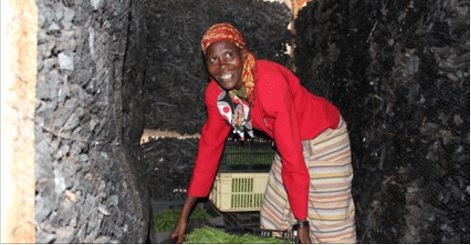
This charcoal cooler room reduces the outside
temperature from 30°C to 8°C
http://www.nation.co.ke/business/seedsofgold/Our-charcoal-cooler-keeps-produce-fresh-/-/2301238/2397960/-/119pv5mz/-/index.html


3 Look to the 3rd World people / underprivileged for idea's on how to cope in what will be, for you, "different" times but for them it is perfectly natural

i)  For storing food long(er) term without adding additional strain on the system / environment, their innovative ways are amazing e.g. charcoal cooler rooms for storing harvests.  Such a blooming simple idea, and it obviously works :)  And is a damn sight cheaper than (electric) refrigeration...
ii)  Learn to preserve your harvests via dehydration or canning - it's not difficult if you get yourself a reputable preserving book.  And is oh, so gratifying, to use those preserves out of season.  Plus you get the added benefit of knowing exactly what is in what you are eating and can be reassured that GMO and chemicals are not forming a hidden part of your or your family's nutritional intake.
iii)  Investigate (a.k.a. Google lol) how they manage to grow crops in their adverse climates (both extremely hot and cold) and what measures they take to ensure that they are able to harvest something / anything...

Those are just a few thoughts I wanted to share with you and they are just a few of the steps that can be taken now that will benefit you in future.

I leave you with this:


http://www.forbes.com/sites/marshallshepherd/2016/07/02/lessons-from-jet-stream-crossing-the-equator-mania/#8535b905a8c3

P.P.S.

This is what the vandals did - this little action affected at least 350 - 500 people!
The power junction box was ripped off
 the tower and the cables were
 disconnected.  I took Escom 4 days
to repair... :(

Monday, 2 May 2016

Growing mung beans

I always buy dried mung beans in order to sprout them during winter.  Just having those to munch on prevents withdrawals of crispy fresh produce during the colder months of the year.

This year I wanted to grow some more chick peas.

But, I accidentally grabbed a handful of Mung beans from the pantry.  My brain was obviously elsewhere - thank goodness I went to the right cupboard though lol

It was only once I had chucked them in the ground of the one raised bed, and had just covered them with soil, that I realized I had sown the wrong crop lol

Never mind.  I thought I'd let them grow and see what happened.

What a stroke of fortune.
A fortuitous, accidental crop of mung beans is
growing in one of my raised veggie beds
The mung bean plant is roughly 40 - 50cms (15 - 20") high and wide.  Given it's compact shape and size, it would be an ideal plant to grow in pots on a balcony too.  Perfect for using as a companion plant with next summers chard, eggplant, raddish and tomatoes, it will also provide some important shade for the ground at the base of those pants.

It is quite a bushy and compact plant.  I planted these quite late in the season, and the plants didn't send out runners and therefore didn't require bean supports and just got on with what they do best - grow mung beans.
Fresh mung beans in a pod
The pods are about 7 - 8cms long and 3 - 4 mm wide.  

Inside, the fresh mung beans sit snugly in their pod.  They are roughly twice the size of a dried mung bean.

And the taste...?

Almost ethereal lol  They are very delicate tasting and different to rehydrated / sprouted beans.
Fresh mung beans compared to dried beans
Honestly, it is quite fiddly to remove the beans from the small, tight green pod, but is well worth the effort.  The dry, dark brown pods 'crack' open quite easily though.

The beauty is, each mung bean plant grown from a single seed will provide 30 - 40 pods per plant or roughly 150 - 250 individual fresh, or future dried mung beans.  The pods form 4 pods together on the plant.  The mung bean plant can hold both fresh green pods, and dark brown pods (which encase the dried mung bean).

(Don't forget to freeze the shelled, harvested dried beans for 24 hours before storing in an air tight jar in your pantry. This helps to prevent weevils infesting your dried beans.)

Apart from providing that necessary crunch factor, mung beans are good for you too.  Check out their health benefits here.

One less thing to cross off my future shopping lists :)

Saturday, 6 February 2016

Grape Harvest

Thank you, kymber - you are a special friend indeed :)


Well, t'would seem that I finally got the pruning of the grape vines right last winter.

For the first time ever I have been able to harvest more than 1 or 2 bunches of grapes from our grape vines.
Some of the grapes I harvested this summer
I always thought that it was the hares that were emptying the grapes from our vines before we had had a chance to munch some, but have just discovered that the mousebirds don't need any help from that quarter and that I had erroneously attributed the loss of grapes to the hares.

When I set about protecting our fruit trees from the mousebirds with the foil trays, I didn't have enough to protect the vines.
Recycled onion net bags - used to protect the
 grapes from the mousebirds
I did, however, have a few empty onion net bags from waaaaaay back when I was still buying them (yes, I am a hoarder, and proud of it ;)  ) so they were wrapped round the larger bunches of grapes.

Thankfully, the limited number of net bags I had worked their magic and allowed me to harvest a third of the bunches of grapes - the mousebirds got the rest.

Big bowls full of grapes to munch on after dinner...
Dessert in the evening :)
... and some to turn into raisins and sultana's.
Dried fruit in the making - they will be a good reminder
 of summers harvest in winter when we eat them :)
 All the squishy grapes weren't wasted either...
Soft, almost discard-able grapes weren't wasted
 either
 ... they were quickly gobbled up by the chickens.
Did you know that chickens l-o-v-e grapes?
I have recently seen those net bags for sale at the co-op, and I will need to get a stock in for next summer.


It has taken 3 years to come to grips with how to prevent (larger) pests from eating our fruit - be that the strawberries, youngberries, apples / pears / apricots / plums / pomegranates, or grapes.  Next year, hopefully, I will be able to harvest more so that we have enough to eat, and a surplus which I can preserve through drying and canning.

That is my aim for summer 2016 / 2017 - to have enough of summer's fruit bounty left over, in one form or another, to tide us through the winter.

Wednesday, 12 August 2015

Winter... or Spring?

Firstly, thank you to everyone who left comments / messages on my last (indulgent) blog posting :)  Funny, thoughtful and thought provoking.  Bless you all.

Back to the subject of this blog posting - even Nature seems confused at the moment.
Scallies - in front of the Rosie
The days are good and cold - now and then.  Not often enough as far as I am concerned.  Scallywag, at 15 years old, is feeling the cold, and can be found in this position whenever the Rosie is lit :)  And even when it isn't - almost as though he is saying, "C'mon guys. light it for me won't you."  (RMan can normally be fond standing in front of the Rosie, too - he doesn't like the cold, and constantly warms his back - much to my annoyance when I am trying to cook 'cos he's in my way lol)
The canola fields from the N2
Driving to town for our weekly shop is exquisite - not only is the countryside green (due to the winter rains) but the canola fields are also flowering.  The contrast of the deep blue sky, the dark green foliage, and the yellow fields - magical!!
Green and gold - apt
I read on someone's blog the other day that they reckon their spring is over - huh!!??  Ours is just starting - our plum trees are in full blossom.  Hopefully the wind goes on vacation so that the blossoms / small fruit aren't blown off the trees...
Plum blossoms - to few to pick a small vase
full for the table, but enough to promise a harvest
this coming summer
... for what would the fruit eating birds do then - never mind us?  I have no plum jam left in the pantry...
The best of all three - plum blossoms in the
 foreground, fields filled with canola flowers, and
 green oats waving in the breeze the background.
The circle of life continues - each with it's own beauty and reward.

But, please - don't hurry away just yet winter - I'm not done with you yet...

Saturday, 1 August 2015

Winter fare

Isn't it funny - you can have the best intentions in the world, but winter always gets the better of you.

I promised myself this winter I would be a good girl.  But, I haven't been.  1.0kg heavier already and still a couple of months of cold weather to go sigh

And, it's all the Rosie's fault.  And my new all the bells and whistle's fridge.  Now that I have freezer space to store "snacks", I'm taking full advantage of it.

RMan and I love nibbling - especially when it's cold.  But, the "ready made snacks' available in the supermarkets are revolting, and a complete rip-off.  More pastry than filling - if you can find any filling at all...

So, I decided that I would make my own.

I boiled up an entire chicken, and when it was cooked, and cold, used the chickeny / herby / garlicky water it had been boiled in to make a gravy.

I stripped the chicken away from the skin and bones and added it to the gravy.

Then I pulled out the phyllo pastry which was in the fridge.  Slathering each sheet with a good dose of olive oil I  cut the sheets into strips.  I used only one strip - you'll see why now...

Taking one of the strips, I added a spoonful of the chicken mixture - right at the end.
The corner of phyllo pastry got pulled over the chicken...
 ... and the corner got folded again...
 ... and again...
 ...and again...
... and again...
 ...and again...
 ... and again...
 ...and again...
That last little bit of phyllo pastry got folded up
against the samosa
 ...and then folded again for the last time.  I didn't worry about the uneven triangle I had created - as long as the filling is securely enclosed and doesn't leak out during the cooking process, to my mind all those bits of phyllo pastry edges which are visible in the pic above = extra crispy crunch in the mouth :)  .
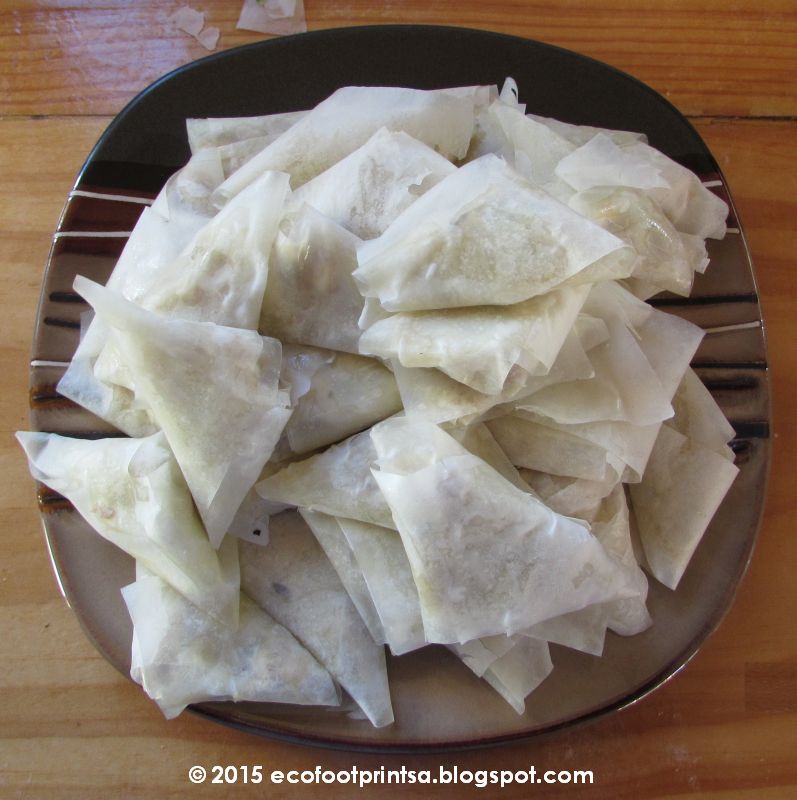
A whole plateful of homemade chicken samosas :)
What was I left with?

A whole plateful of chicken samosas.

One strip of phyllo pastry got folded 10 times - equivalent to ten layers of phyllo pastry :)

3/4 of the plateful has gone into the freezer.  The other 1/4?  As soon as we light the Rosie later this afternoon, and it gets to temperature, I'm going to have a nibble :)

(I can't wait to posts this, so I'll add a pic of the cooked samosa's when they're ready :) )

1½ hours to cook / simmer the whole chicken (which also became chicken pie and chicken à la king), 15 - 20 minutes to boil and reduce the stock and make the chicken gravy, ten minutes to strip the cooled flesh from the carcass and 20 minutes to roll the chicken and gravy mixture spoonfuls in the phyllo pastry.  Effectively, it took 30 minutes of actual work to make enough chicken samosa's to last us a month (I hope...lol)

Who needs to buy ready made nibbles, when they are so easy to make yourself?

Update:
Baked at 200°C for 20 minutes and served with a
chopped side salad and some chilli sauce.
Dunno what happened to the sauce, but they
tasted full of moist chicken - goal accomplished :)
RMan wanted to know how many I made, and how many I had left in the freezer.  He says 24 is not enough... ;)

They were, even if I say so myself, absolutely, excellently yummy, crispy, and tasty!!

Tuesday, 21 July 2015

Naturally storing

I saw this a few years ago, and thought it an excellent idea.  And, typical, with the move from town to the farm, completely forgot about it. 

Jihyun Ryou: a Korean artist about her storage
 solution for vegetables
https://www.youtube.com/watch?v=mG9xYVyAnuc
The link in the pic above an excerpt from the file "Taste the Waste"  by Valentin Thurn from 2012.  (It's very frustrating - I understand that making films / documentaries costs money, so I totally understand that the movie was offered for sale.  But, c'mon - that was in 2010??  Surely the message would get to a far larger audience if it was now offered for general viewing?  And surely that is the motivation of the movie - to educate people?)

Anyway, soapbox moment over...

Then I saw the excerpt again a few days ago.

OK - so I figure that someone's trying to tell me something.

So, I decided that I was going to try it...

Why not - in summer the more space you have in a fridge, the better :)

But, I'm being a good scientist - I'm using controls :)  (if only my old science teacher could see me now lol)
Carrots in damp sand, and control carrot on
the side
So, into a large-ish vase went some carrots and some damp sand.  With a "bare" control carrot lying on the side.
Carrots in bag in veggie drawer of the fridge
Half of the bunch of carrots harvested went into a bag the fridge...
Carrot on the shelf in the fridge
 ... and the fridge control one was left exposed on a fridge shelf.

Yes, I could leave the carrots in the ground, but with the hectic heat (and lack of rain) that we have here in summer, they tend to bolt quite quickly.  In addition, I have discovered that the moles have a penchant for carrots.  Nothing worse than planning to have carrots for dinner, and going out to harvest some, only to find that the leaves and a very small amount of the actual carrot remains in the ground.

Then - the apples and potatoes...

I am so tired of potatoes going "mushy" - even when I store them in the dark cupboard under the stairs.  I mean, I can't even plant sprouting tatties - 'cos they don't sprout.  They just go squishy and soft and revolting.  The only place that is good enough for that is the compost heap.  What a waste!
Potatoes below apples in the veggie rack
So, I have this small kitchen unit and on the upper shelf I have placed some granny smith apples, whilst below is the  "basket" of potatoes.
A "paper wall" blocks the light
from hitting the potatoes
I have covered the front of the wire basket with paper to prevent the potatoes being exposed to the sunlight which shines straight in on the unit in the afternoon.

Two weeks later :

Whooop!  Whooop!  Wow!!!
Now that is a carrot that even the alpacas
would probably refuse
This is the control carrot left on the kitchen counter next to the sand filled container.  As you can see it is pretty unappetizing - and wrinkled and soft.  Not even good enough to feed to the alpacas.
The carrots in the damp sand are still firm and
perky.  In fact...
These are the carrots in the sand.
... they are sprouting new leaves
 And - a distant shot of the carrots in sand.  But, if you look carefully at them you can see something that blew me away.
The carrots in the damp sand are even sprouting
new roots!
 They are so loving being out of the fridge, and still alive, that they have started producing new leaves... 

... and roots :)  I'm blown away.
Another sad looking carrot - this is the one that was
left exposed on the fridge shelf.
The carrot left open on the shelf in the fridge - t'is also looking worse for the wear.  Not quite as sad looking as the control one from the kitchen counter, but not as good as the ones in the packet in the fridge, and definitely not as good as the carrots in the damp sand.

Naturally - the carrots in the bag in the fridge are fine - except they aren't growing leaves nor roots lol

Pretty successful I reckon!!

Just for the fun of it I'm going to leave one carrot in the damp sand, and see what happens to it over the next few months.  Will it grow another / more carrots, will it go to seed?  What will it do?

I never thought I'd be displaying vegetables in my house like a pot plant lol