"Self-sufficiency does not mean 'going back' to the acceptance of a lower standard of living. On the contrary, it is the striving for a higher standard of living, for food that is organically grown and good, for the good life in pleasant surroundings... and for the satisfaction that comes from doing difficult and intricate jobs well and successfully." John Seymour ~ Self Sufficiency 2003
Showing posts with label global warming. Show all posts

Monday, 29 January 2018

LOA

I will be taking a leave of absense from this blog.  I have started another blog to help the residents of Cape Town who are about to hit Day Zero.  

Day Zero is when the 5 dams which supply Cape Town hit a collective total of 13.5%.

It is the day when level 7 water restrictions take effect and when everyone within the Cape Town metropole is limited to 25 ltrs (+/- 6 gallons) of water / person / day.  That 25 lts must include what they need for drinking (hydration), food prep, hygiene, cleaning, laundry, pets, etc and also covers what they use at the gym school and workplace...

It is no mean feat.

Day Zero is currently expected to hit on 12 April 2018.  Should weather conditions remain hot and windy, evapouration will bring that date forward.

All the hints and tips I'm sharing on this new blog are from the members of the Water Shedding Western Cape facebook page.

Having them all in one place, makes them easier to access - and removes the negative, complaining posts that tend to abound in public forums / facebook groups.

Necessity is certainly the mother of invention!!  I'm blown away with the amazingly innovative ways that people have come up with to reduce their water usage.

You're welcome to join in - you never know, one day you too may need some assistance, or idea's on how to live with 25 ltrs / person / day...
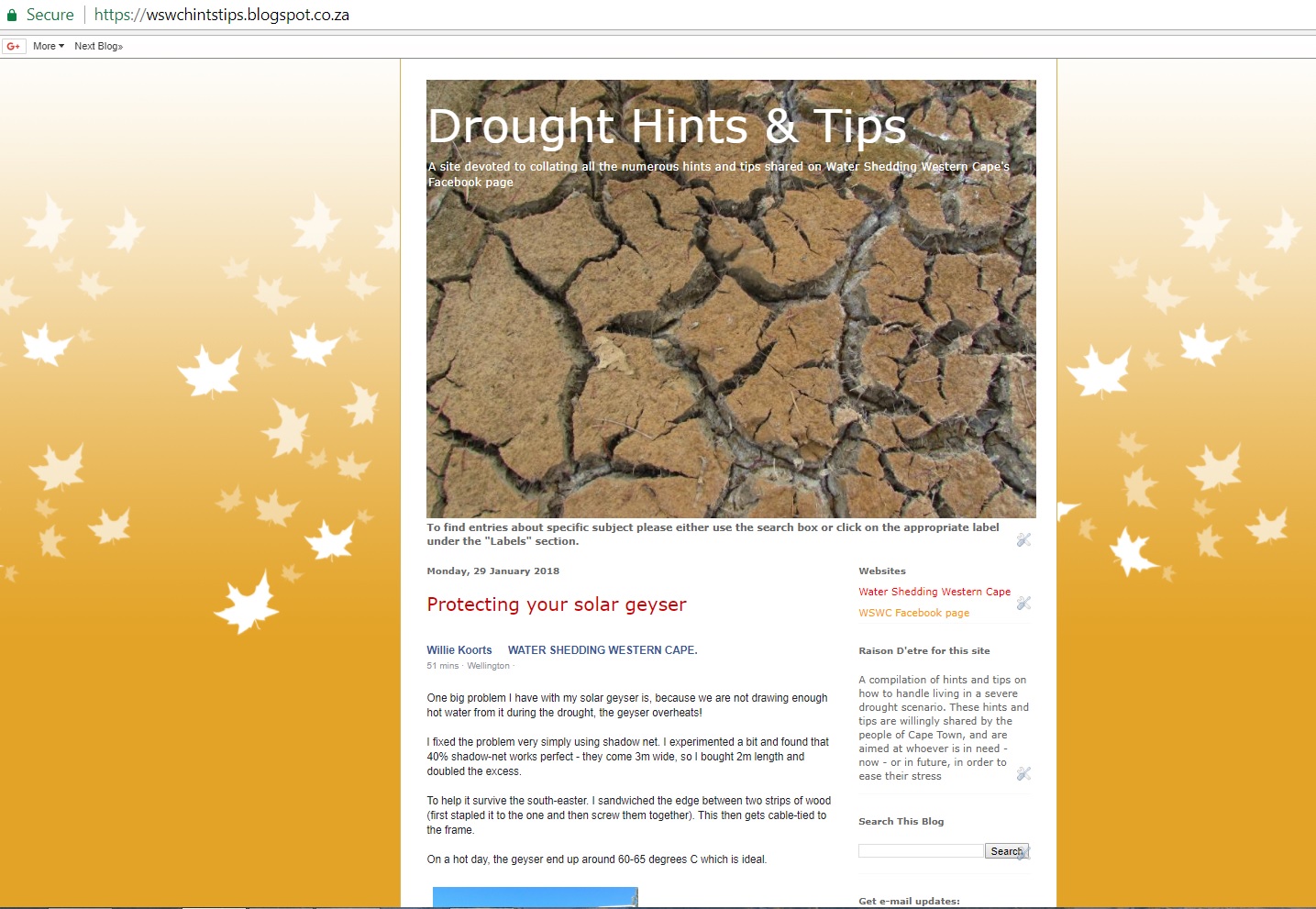
https://wswchintstips.blogspot.co.za/

Saturday, 16 December 2017

Disturbing

They were found in on our windowsills, and on our floor, in just one day.
14 dead bees - what caused this to happen in only ONE day?
What is the cause?

It could be the drought.

It could be the chemicals sprayed by the farmers on the surrounding fields.

It could be the loss of habitat or the lack of crop diversity ( http://sos-bees.org/causes/ and http://sos-bees.org/wp-content/uploads/2014/04/BeesInDecline.pdf)

It could be the increasing levels of CO2 (https://e360.yale.edu/features/bee_collapse_co2_climate_change_agriculture


Whatever the cause, life without bees will be very, very different.  There will be no pollinating of crops.  No crops, no food.  No food...

And no honey.  Imagine life without honey - whether you spread it on freshly baked bread, stir it in your coffee, or apply it to a cut.

I, personally, do not want to even think, never mind live, on a planet without the bees.
A simple source of water for the bees on a hot summers day
And they need our help.  Do you use chemicals to control pests in your garden, or do you employ eco-friendlier options?  Do you do something as simple as putting out a bowl of water for these important insects to help them cope with the summer heat?

I believe that is the least we can do for these busy, busy bees...

Saturday, 30 September 2017

Safety first

As you all know we live on a smallholding outside Swellendam, and our water is supplied by Overberg Water (OW) in Heidelberg to one distribution point near our valley on the N2. Between us and OW in Heidelberg are kilometers of main water pipe, which, without fail, during December / January of each year, is damaged by farmers ploughing their land.


When we moved to our smallholding at the end of June 2012 there were about 16-odd permanent residents and 5-odd weekenders.  Since then that figure has grown to 37 permanent residents and 11-odd weekenders.  Additionally, our valley water supply from that one distribution point on the N2 is further distributed, via (unsecured / unlocked) 5 000lt tanks placed strategically around the valley, and, as newcomers purchase their smallholding, and request a water connection, the main valley supply pipe is again severed in order to connect their individual water meter.

All these breaks in the line - whether accidental or intentional - invariably result in foreign matter / contamination entering our water supply.

Both these situations have concerned RMan and I.

We have made alternative arrangements so that we, personally, are more water secure - through our 5 000lt potable water tank, and our 8 X 5 000lt rain water tanks.

But, the tank vulnerability and "foreign matter" still concerned us.  Finally, last week I asked RMan if we could get a combined early Christmas present, and take steps to mitigate that potential problem.
Travel Berkey
We saved up all our pennies and have finally purchased a Travel Berkey. The Berkey water purification elements are so small that they can even filter food colouring out of water and thus "an exponential increase is realised in the efficiency at removing pathogenic bacteria and other waterborne contaminants. Super Sterasyl Ceramic Filters remove pathogenic bacteria, cysts, organic chemicals, chlorine and reduce sediment, turbidity and particulate. Black Berkey Filters do this AND remove lead, MTBEs and other heavy metals." Both filters have similar life span and require similar cleaning.

The farmers round us spray glycophosphates on their land, which obviously, as is the nature of a spray, lands on our roof. Our rainwater will thus probably be contaminated too. But "Black Berkey® Purification Elements will reduce Glyphosate in your water by greater than 75%, exceeding the laboratories reporting limits."

Yes, it is quite an expensive purchase, but the filters will last for 6 000 gallons or 22 600ltrs or - not being spring chickens anymore - they will probably the rest of our lives 😉

And then one of our kids can inherit the system. 😁

Personally, I'm very relieved, because this system will not only provide clean drinking water for us now, but will also allow us to filter our rain water, and even our muddy dam water, if necessary at any time in the future.  Providing the dam is still holding water though...

                           --------------------------------------------------------

After I had concluded our purchase, I wrote to the local supplier, Riaan, (http://www.water-purifier.co.za/and asked him is he would be prepared to sponsor a Berkey to a member of a Facebook Group to which I belong.   He very generously has said that he will.  So, for all of you who have a Facebook presence, please, if you live in the Western Cape, join both the Western Cape group

https://www.facebook.com/groups/watersheddingsa/ and the main watchdog group

https://www.facebook.com/groups/924585607595490/ 

In order to make yourselves eligible to enter and win this brilliant giveaway.

Those Facebook groups are doing sterling work at assisting everyone to survive the current drought - through sharing important notices from the authorities, and through allowing everyone to pose questions / get answers / share hints and tips from the general public, as well as giveaways such as this.  Please - there are various other groups in other provinces - join your area's group here:

Free State:          https://www.facebook.com/groups/1104758469627319/
Gauteng:             https://www.facebook.com/groups/1409690155743938/
Kwazulu Natal:     https://www.facebook.com/groups/512238275796563/
Mmpumalanga:    https://www.facebook.com/groups/128995167833468/

The Facebook page Admins will be advertising the giveaway shortly.

Finally, if you think it won't happen to you, on Thursday this week the following notice was issued by the Western Cape authorities / government:

The situation is dire.

South Africa - the whole country - is predicted to be hit hard - very hard - by the effects of climate change / global warming.  As with the assistance that farmers are getting from other farmers for feeding their drought affected animals, through helping each other on these groups we will all weather the situation far better by joining our mutual resources / information.


Postscript: I paid in full for my Berkey.  However, I did tell the local distributor, Riaan, that I would mention his company by way of thanking him for his generosity in accepting the giveaway request from a total stranger - me - and for his generosity to the winner of his giveaway.  Please - visit his website and check out the range of Berkey's.  Perhaps one will suit your pocket 😏

Saturday, 29 July 2017

Fighting the effects of drought

Back in August 2016 I wrote about some extra special treatment that the fruit trees were going to get.  Chickpea said she looks forward to hearing about it...

So, Chickpea, here you go 😃

I first read an article in the local "Farmer's Weekly" back in June 2016.  Given the number of fruit trees we have (mainly our lemon, but also apricot, pear, apple and plum, as well as our berry and granadilla bushes) it piqued my interest so I contacted the inventor - Louis.  It turned out that he lives near us - in Bonnievale - about an hour or so drive from us.

I have, albeit from a distance, painfully lived through the development phase with him - impatiently waiting for his mould to be manufactured so that he can go into production of his recycled plastic water saving device - the TreeHog.

This will be a 100% SA product :)
A local farmer has developed a "box" to place
 around the base of the trees in order to 

preserve irrigation water
And is stated to be 100% recyclable.
70 TreeHogs awaiting installation
He finally stated production earlier this year, and I ordered 70 units which were received 2 weeks ago.

He has, with his prototypes, cut down his watering from 4.5 - 5 hours twice a week, to just 20 minutes twice a week - and that irrigates to a depth of 400mm.  The amount of water used - 11 litres / tree twice a week!!  That is one massive water saving!

The principle pf the TreeHog is that the water sprays inside the unit, hitting the walls.  It then runs down the walls to the soil (and tree roots) below, where it is absorbed.  The wind cannot deflect / waste the spray, and, being enclosed, the soil below is kept damp as the sun is pelting down, and the prevailing wind cannot cause evapouration of the moisture in the damp soil.  Given the opening at the top, any heat inside the unit is expelled up through that opening.

Given our current drought ...
Rainfall record from Nov 2013 to July 2017
and predicted future water scarcity situation due to global warming, our fruit trees need all the help we can give them.

Take a look at this link too:

https://grist.org/article/the-first-half-of-2017-was-the-second-hottest-to-date/

The information there may give you pause for thought.

Our lemon trees are now - 7 years old and we are getting very little harvest from them.  Lack of water is, I think, the cause.  We feed them, and have given them water regularly.  But, fighting extreme heat coupled with reduced rainfall, doesn't help a tree produce it's crop.  Add to that 5 busy chickens who delight in moving every scrap of mulch we have placed below the trees, and you'll have some idea of what we've been facing...
Attaching the sprinkler or drip irrigation head to the inside of
  the TreeHog s simple.
The TreeHog opens up on one side and allows you to place the required irrigation head in a corner - according to your requirements.  Closing up the Treehog again is simple and a couple of cable ties holds the unit closed round the base of the tree.

Stay tuned - I will report back on the TreeHogs at the end of this coming summer. Not all our lemon trees / fruit trees ( or bushes) will get a TreeHog, so, in effect, I will have a control in place.  The difference is going to be interesting to note...

If anyone else would like some for their precious trees or shrubs:  http://www.treehog.co.za/  The cost, at R59.00 each, are not expensive.

The TreeHogs round the base of the trees look quite cute, don't they 😅
Although the tree in the foreground is a wild plum, we don't
 have the nerve to move it.  Given it's size I don't think it would
 survive, and we leave the fruit it produces for the birds to enjoy.


Disclaimer: I received absolutely nothing in exchange for sharing this info - it is merely my ongoing 'sharing is caring' taking place 😉

Sunday, 2 July 2017

Saturday, 24 June 2017

Rain water harvesting installation

I am a member of two facebook groups which try to assist people in the Western Cape, as well as the rest of South Africa, with regards to drought solutions - namely Water Shedding SA and Water Shortage South Africa.  I know that most of this will be of interest to South African readers, but, perhaps everyone should be aware of, and will benefit from how to help themselves to become more self-sufficient with regards to their water - and it's storage - especially rain water.  Water is our most precious comodity - more valuable than gold, diamonds, oil or anything else considered precious by mankind.

In those groups I have read so many posts from people asking who can install their rain water tanks. I think the "lack of knowledge" and cost implication (of firstly purchasing the tank, and then the additional cost of getting a company to come and do the installation / gutter link up) may be preventing people from installing a rain water tank. So I thought I would share the simplicity of it.
For those of you are new readers of my blog, here is some background: we live on a 2 Ha smallholding and we have installed 9 X 5 000lt tanks over the past 7 - 8 years.
Our potable water is directed from our mains pipe into the top of
 the potable water storage tank
 As our "mains" water supply is erratic (either Overberg Water has "pump" / Escom power supply problems or farmers accidentally plough up the main line - this happens quite frequently) so we have dedicated one X 5 000 lt tank to potable water. Given the aforementioned causes of possible breaks in our potable water supply, water independence / security is therefore imperative for us - especially in the heat of summer.
Details of water connection from pump to the house, and our
 power source to the pump
Of the remaining 8 X tanks, 3 X tanks are positioned at the end of gutters and collect rainwater and the balance of 5 X tanks are postioned on the higher parts of the land in order to irrigate via gravity and / or pump.
A secure base is vital for a water storage tank
Please ensure that you either position your tank on a (smooth) concrete slab, a square of level pavers, or a good 10cm thick bed of gravel (please ensure that there are NO SHARP GRAVEL POINTS sticking up or they could puncture the tank).
Our tank / pump connection
1 000lt (filled weight is 1 ton), 2000 lt (filled weight is 2 tons) or 5 000lt (filled weight is 5 ton) tanks are heavy when they are full, and when the ground beneath them is wet from (hopefully good 😀👍👍 ) rains, the risk of the tank falling sideways / collapsing is a possibility IF the tank isn't sitting level. This definitely applies to a clay soil - as clay is "volatile" when very wet.


Two pics showing one of the two types of valves we used - in these pictures the image on the left with the handle pointing upwards, the valve is closed and in the image on the right showing the handle lying parallel to the valve, the the valve is open.

When you purchase your tank(s) ask the supplier for the specific water tank fitting requirements. Then, either get them to supply those parts, or get the tank supplier to write them down and take that list to your local hardware store. Don't forget the plumbers tape - to seal ALL the connection threads 😀  The majority of tank fittings are 40mm - both the inlet and outlet points. If you want to reduce that outlet size in order to connect a normal garden hosepipe, then your hardware store will know, and supply you with those fittings as long as you know the diameter of garden hose that you use. From tank outlet fitting size of 40mm to 1/2 inch garden hose = 12mm fittings, or 3/4 inch garden hose are 19mm fittings.
You will see two different valves in the pics - a plastic one and a metal one. Either valve can be used quite easily and is only dependent on what your hardware store stocks.
Cutting the water tank lid in order to insert the gutter downpipe can be achieved with the use of a utility / Stanley knife. Mark out the gutter profile on the lid, drill a "start" hole and cut away...
Shadecloth filter catching debris from our roof and preventing it
 from entering the tank
We use a piece of 80% shadecloth as our debris fiter and it works well. Hooking it over the water tank lid securing pin "protrusions" ensures that it is held in place.
It's easy to cut a hole in the top of the tank lid with a utility or
 Stanley knife
Also, when the lid is in position the "close fit" adds to that shadecloth filter position securiity. Ours have not moved in 7 - 8 years. Emptying the debris is as simple as lifting off the piece of shadecloth, shaking off the debris, and replacing the shadelcoth over the tank securing pin protrusions.
The lid helps to keep the shadecloth in position
First flushes are also easy to install and, if you go that route, I would recommend that you have a large mouthed valve at the end of the first flush pipe in order to facilitate easy expulsion / removal of the debris. Please remember to use a PVC weld if you are joining fittings with no thread. This is also obtainable from your hardware store.
Open source diagram of a first flush system
Another first flush diagram
If you want / need to connect your tank to your house you will need a pump and the knowledge of how to do this. If you do not know how to do this, ONLY then you would need to call on the services of a plumber.
I recommend a wide mouthed valve at the end of your first flush
 pipe to enable easy cleaning of the debris within
I know this seems to be a lot of info to absorb, but most of it is commonsense if you logically think about what you are doing.

Good luck 😀

Saturday, 17 June 2017

Hydroponic update

You'll remember last year back in April I started a small hydroponic system.

This is a report back and a change of plan.
My newly installed small hydroponic ssystem
The lettuce still found the direct sunlight too strong and went to seed.  I will have to grow them in the shade next summer, with light being provided by bouncing it off a north facing wall.
The cabbages grown in the ground, without question, performed
 better than the hydroponic ones
 The cabbages - nope, not successful.
The hydroponic peas did well, and also didn't display any signs
 of "mildew" on their leaves
The peas?  They did beautifully 😄

And the tomatoes - they produced nicely - though not as well as those that were planted in the ground.

So, not a great result.  Not a "Yeeeha, Eureka!!" moment.

Perhaps it was my "feeding" of the water.  Being out in the sticks, and not wanting to incur costs buying and transporting hydroponic plant "food" I only used a seaweed concentrate in the pump tank.

But, I am not discouraged.

So, I have drawn inspriation from this pic I saw a while ago...
This image inspired me to plant strawberries in gutters which
hang on either side of my raised beds
As you know I hung gutters on the side edges of my raised beds and planted strawberries in them.
The current situation / progress of my gutter strawberries
(nope, they aren't battling weeds, but rather self-seeded
 rocket seedlings.  I love rocket, so I'm letting them stay
where they fell)
They are doing well, and this seasons strawberries are beginning to form and hang down the sides of the gutter.    So, I have decided to use the hydroponic pipe to grow strawberries and I will leave the exisiting  strawbwerry plants in the gutter for comparison.

Yes.  I can grow strawberries in the ground, and they have been successful, but the slugs have been just as successful in their quest to devour portions of every strawberry that happened to touch the soil.
The reserve / return reservoir which collects the pumped water back
 to the pumping tank via gravity.
I have suspended a stocking filled with organic fertiliser beneath
 the pipe's overflow outlet.
In place of the seaweed concentrate, I have added a measured portion of organic fertilizer to a stocking which hangs into the return water reservoir.  Everytime the pump switches on, the water falling into the reservoir falls onto the stocking (and it's contents) thereby "disturbing" it and releasing the nutrients.
The organic fertilizer RMan uses for our fruit trees
I planted the hydroponic strawberry runners about 3 weeks ago, and already the roots are beginning to grow out of the bottom of the yoghurt containers I use as hydroponic plant pots. 
New strawberry runners planted three weeks ago are already
 producing roots outside of the tub.  The strawberries were planted
 in a palm peat / vermiculite mixture.
I have the pump on a timer which switches on for 15 minutes every hour from 7.00a.m. to 7.00 p.m.  After that the water which remains in the pipe must suffice until the pump circulates the water again.
A shallow "bowl" of water permanently remains in the base of the
 pipe for access by the plants when required.  It doesn't fill the
 pipe completely and thereby provides air to the roots as well.
The new strawberry plants seem happy and are beginning to grow new leaves.
That, to me is a happy looking strawberry plant 😃
Let's see if I can get it right this time...

I am determined to be successful, as, given climate change / global warming / predicted global water shortages, I believe that hydroponics will figure massively in the future with regards to feeding the masses.  Being inquisitive, I would like to understand the process / problems in using this growing method.

Friday, 16 June 2017

Wake up call

I seem to be quite negative in my postings lately - my apologies.  But I think when life hands you lemons you still need to gather the lemons together in order to make lemonade.
Image source: Digital Globe
Images collected on June 14th show the devastation from
 the unprecedented wildfires in Knysna, South Africa. The before
 and after comparison show near-infrared images displaying
 healthy vegetation in red, and burned areas in black/gray.
The recent catastrophes (storms and fires) in the Western Cape have been horrific to experience / watch.  300 kms of the picturesque Garden Route was completely obliterated.  Hundreds of thousands of people lost everything.  11 people are known to have perished in that fire, and who knows how many animals.  Thankfully, in anticipation of the storm, the provincial government closed schools on Wednesday 7th June.  Thankfully, because 135 schools were damaged...

 RMan and I are now hyper aware of how vulnerable we all are, and will, where possible, take measures to prevent a major calamity of this type from negatively impacting us - as far as we possibly can.

We are currently rectifying the damage that was done to our house by the gale force winds which we experienced - barge boards ripped off / destroyed and roof tiles blown off.  To say that the winds were scary is an understatement.  Add to that runaway fires...  We did have a fire spring up in the nearby village during last Saturday's gale force wind, but thankfully the fire department managed to sort that out - only God knows how they did it.  That fire damaged our Internet tower and we were without a connection for 5 days whilst the tower, wiring and the equipment was replaced.

My heart bleeds for those affected in the garden route - the 1 000's of homes and lifetime memories lost, the lives lost...  Just too terrible.

In our area we all received the Overberg Water Drought letter with our water accounts recently. Drought restrictions and penalties are now in force.

A link to Duivenhoks Dam which supplies us with water 
(https://www.westerncape.gov.za/general-publication/latest-western-cape-dam-levels)
shows that the dam is still reflecting 62% (as of 2/6/2017) so personally, I have not been too perturbed.

However, on looking at my rainfall records, a different picture emerges. (see image below).
Rainfall records from Nov 2013 to June 2017
What this means for our summer season time will tell...


For those of us that grow our own vegetables / fruit bearing trees a tip I'd like to share is that Sutherland Sawmills in Swellendam sells wood mulch (fine and coarse) for +/- R50.00 a trailer load. We did this last summer and have found that placing a thick layer round our veggie beds / base of our trees helped them to conserve water during the hotter months thereby assisting in ensuring their survival and their intended function i.e. food production. As wood mulch apparently temporarily ties up nitrogen in the surface of soil against with which it has contact, ways of replenishing that nitrogen is through the addition of an organic nitrogen supplement e.g. alpaca, horse, cow, chicken manure and even human urine - even (non-seeding) weeds will fulfil this function for as they break down they return to the soil what they have taken from it in order to grow.  I know that very few of my readers live in our area, but I'm sure if you Google you'll find a sawmill or bulk mulch supplier close to you.

Helping each other helps all of us enjoy our individual patches of heaven 😀


Anyone have any other water saving / disaster avoiding tips that they'd care to share?


Note to Sol if you read this post:  Permission to view your blog is denied to me ;)  Maybe you need to send me another invite?  

Saturday, 27 May 2017

Bear with me...

... whilst I recover from a second (nasty) bout of bronchitis this year (courtesy of a 3 year old grandchild's playschool).

I have some stunning news, but can only share it once I receive what I am waiting for.

In the meantime, here is a teaser of sorts... 😉


Sunday, 21 May 2017

If there's something strange in your neighborhood...


...who you gonna call...


You all know how that song continues, but they're not going to help in this situation.

You, me, your neighbour, your family, strangers - they're the only ones who can pull the trick out of the hat.

Snakes - we - or more correctly Stellar - found a puff adder in the alpaca feed shelter last Friday.  RMan noticed that Stellar was behaving weirdly so called her inside whilst he went to investigate.

Yup, a roll of shadecloth in one of the (un)used bins was moving.

Thankfully, John, the odd-job guy who helps us was there on that day and between RMan and John it was  dispatched.

He then spoke to one of our neighbours who told him that the caretaker of our neighbours property found 4 Cape Cobra's and 2 puff adders - in the last week!!!  That is scary stuff...

Snakes should be hibernating at this time of year.

For goodness sake - we're exactly a month away from mid-winter!
This Paulowina tree should only be flowering in September -
 not now...
Then, this morning we noticed that our Paulowina tree is flowering - that shouldn't be happening yet - historically it should only happen in September.  The seasons are definitely wonky.  And, as much as I can handle what is happening, can the farmers?

Our weather has even made international new weather reports:

CNN Cape Town weather

Finally, have you read the latest about the moss growing in Antarctica?

If we don't all change our ways and consider Mother Earth, and the harm we are collectively doing to her, then she will reject us.

Are you more ready for that rejection than doing your bit now...?

It's our choice.  

Tuesday, 18 April 2017

Mid-to-end April 2017

Bearing in mind that we are supposed to be in mid-winter in just over 2 months time, I have absolutely no comment to make about this...

Mid-April 2017 predicted temperatures
... apart from the fact that this is not usual.  Not usual at all...

Add to that these rainfall figures, and you know exactly what is happening here...
The rainfall figures so far this year are very, very worrying...

All that will help is prayers.  Lots and lots and lots of prayers.  Please.

Saturday, 11 March 2017

Water wise boundary decor

I started this blog posting back in July last year when we first started on this project...

RMan and a neighbour, E, used to do the installation and maintenance of the potable water system, and the reading of each individuals water meters in our smallholding communnity.  Even though there are 150-odd smallholdings in our area, we are not "formally" recognised by the local authorities as a "settlement" and are thus not entitled to "services".

Whilst travelling to do the water meter readings RMan spotted these plants growing at the entrance to once of the smallholdings.
I'm sorry I didn't get a pic of them in flower - they looked seriously impressive!
However, RMan did pick up some of the fallen flower buds / seed carriers.
No exactly sure how to propagate agaves,
 I just plonked the base of the "flower" into
 some potting soil and hoped for the best...

Not finding any info online on how to propagate agaves, I just plonked the bottoms into a pot of soil in effort to try and grow them, so that, if I am successful, we could then place them, together with some aloe plants, along the front (dirt road) fence of our property.  They may not look like much sans flowers, but they are certainly water-wise, and will help to distinguish our property from the others nearby.
Aloes with red flowers...
Isn't it funny how your tastes change.  Before we had our smallholding I used to think that these types of plants, and aloes, were damned ugly.  Now I understand why they are grown - for their hardiness, drought resistance, and striking feature qualities.
... and aloes with yellow flowers
Fast forward from July to March 2017 and this is actually what was planted along our boundary this week:


The successfully rooted Agave plants
http://www.southafrica.net/blog/en/posts/entry/a-spiky-kind-of-beautiful

Kei apple trees
https://www.plantzafrica.com/plantcd/dovycaf.htm
Spekboom - propagated from our existing plants
https://en.wikipedia.org/wiki/Portulacaria_afra
Also, I understand that spekboom is excellent at
 carbon fixing - so, to help reduce our carbon footprint,
  I need to grow as many as I can, I reckon.

Home propagated lavender

NumNum bushes
https://www.plantzafrica.com/plantcd/carisbispin.htm

Geraniums propagated from our existing plants

The boundary fence March 2017 - it looks like nothing at this
 point in time, but I have high hopes of a stunning boundary in
 years to come.
 We have planted groupings of 14 plants / section so it
 should make quite a feature - once they are all grown up... 
We have planted groupings of 14 identical plants per section, so in years to come it should, hopefully, look stunning! 😉

Three of the plants are edible (Kei apple, spekboom and numnum) and all are waterwise 😃  Which is just as well as our drought continues and we have had only 5.5mm ( .2 of an inch) of rain since the 12th February...😟

Although I have never served spekboom in a salad or soup for our personal consumption - yet - apparently, alpacas can also eat it.  Due to their carbon fixing properties I'd love to plant up a whole field of them...  (Don't tell RMan, but I think I'm going to surreptitiously get that going.)

You can read more about the history of South African agaves here.  It's a pity that neither RMan nor I drink tequila... ;)