"Self-sufficiency does not mean 'going back' to the acceptance of a lower standard of living. On the contrary, it is the striving for a higher standard of living, for food that is organically grown and good, for the good life in pleasant surroundings... and for the satisfaction that comes from doing difficult and intricate jobs well and successfully." John Seymour ~ Self Sufficiency 2003
Showing posts with label alpaca dung. Show all posts

Saturday, 21 June 2014

Frostbite


Very exciting things are happening at the Foothills Organic homestead today, but, as they aren't finished, I can't tell you anythng more... yet :)

What I can tell you though is that I was caught napping.

Although we had frost last year, I didn't loose anything to it.  But this year it's different.

I had sweet potatoes chitting for ages, and planted them in the repurposed tyres we have.  Last summer the tyres produced more than enough butternut squash to see us through winter, so I thought sweet potatoes would be a good crop to follow the butternut.

I filled them with lots and lots of gorgeous alpaca poo mixed in with the soil - it had to be a winner.  I thought.  I almost gloated.  And I definitely salivated at the prospect of the harvest.
Frost bitten sweet potatoes - are they
ex-sweet potaotes? Time will tell.  But, I
liv
e in hope :)
But - as you can see, the frost got them.  The field mice had been nibbling at the leaves in one of the tyres, and what the mice didn't damage the frost did.

I'm not sure if they will sprout again?!  But, I've left them in situ with a protective straw covering - just in case.

Strange that, because I'd grown sweet potatoes on the farm before, and they didn't suffer from frostbite - maybe we just didn't have frost that winter...?
An eggplant in the protective cover of a broadbean
plant.  But, it still got the brunt of recent frost.
My mini forest garden didn't help...
Another crop which was grown out in the open for the first time were the eggplants.

They also came a cropper.

So, I'll just have to harvest what is left growing on them, share some with RSon (who is visiting this weekend) and Natasha, scoff some of them, and preserve the rest for later.

But, the lesson will be filed away securely for next winter.  Frosty isn't going to wreak havoc in this garden again - if I can help it :)


Don't forget - if you'd like to score some piquanté pepper seeds which I am giving away, please leave a comment on
http://ecofootprintsa.blogspot.com/2014/06/preserving-piquante-peppers-and-give.html before 6.00p.m. on 30 June 2014

Sunday, 23 February 2014

Towards the end of the season


I am embarrassed to confess that I made an error in the calculation of the birth date for Miranda's cria.  When I looked at Miranda's records which were handed over by the breeder, I took the last date which was reflected and calculated from there.  But, the last date is the date she gave birth to her previous cria - not her mating date.  So, I have to add 10 - 12 days to that to get her cria's due date.  Which means that her cria isn't due until 5 - 8th March 2014...!

Can you see my embarassed red face...?

So, to get to more mundane matters... LOL

We have had a really strange growing season here.  It's not that we haven't had the temperatures either.  I reckon our average daily temps have been in the high 20's to low-mid 30's for the past two months, with the occasional 37 - 39oC.

My tomatoes are only just beginning to ripen - in Feb / March!!!?!  The seeds were planted in September, and took ages to mature.  The ripening of the fruit is complementing that initial delay.

But, some of my tomatoes plants have an illness.  And I need assistance in establishing what it is.  So here is a pic :
Why have some of my tomatoes developed
a black core?
Can anyone tell me what the problem is?  Is it contagious, and should I whip out the plants chop-chop?  This is how I found them on the plant.  Beautiful from the top, but when you turn them over...!  Even the green ones are the same...  Given this or the tomatoes being eaten by mice, I think I might prefer the latter...

I tried growing cucurbits in tyres, strawbales and the ground.

The most successful was the ground - a lovely deep hole filled with alpaca dung, soil and straw.

By the way, alpaca dung is proving invaluable - if you have an alpaca farm near you, please, try and get some of their dung.  Vegetables absolutely love it!
A pumpkin in the making
I have given away a couple of pumpkins, and have at least 8 left - more than enough to get us through the coming winter.

Secondly, the tyres also proved a winner and produced plenty of butternut.   So much so that I have been able to share the bounty with neighbours and family and still have 10 left over for winter :)  Yummy - stuffed oven-baked butternut, creamed butternut, butternut fritters, butternut soup - I'm salivating at the thought of cooking them in my Rosie :)

The butternut plants did develop a bit of leaf mould, but I removed the infected leaves (and continue doing so as soon as I notice them), and the plant is still producing, so it obviously doesn't mind being "pruned".

But, the strawbales didn't work for me.

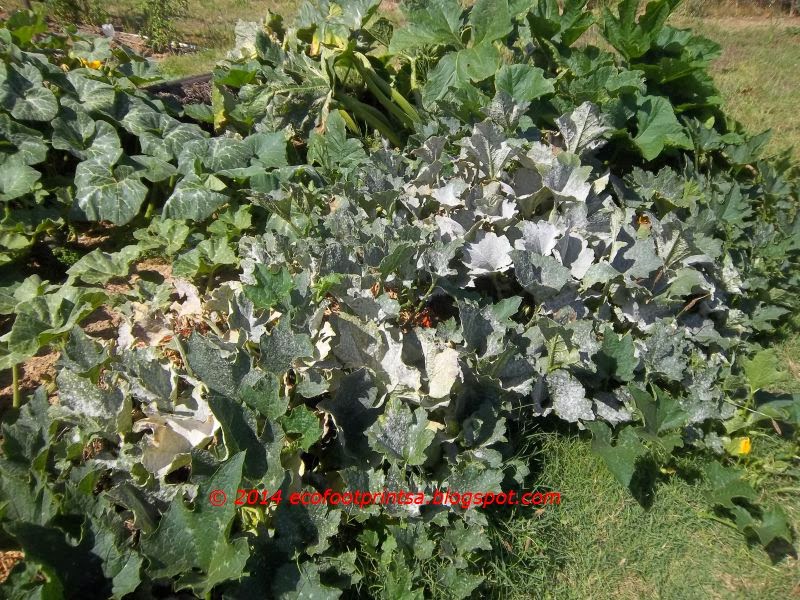
Firstly, the squash plants developed leaf mould.
Leaf mould on my squash plants - I Know I was
a very sloppy gardener to allow the plants to get
to this stage - but this was after I had
treated the plants with Sk Eco spray...!
Hectic leaf mould which I didn't notice early enough - "it's not easy to see in the glare of the sun, she protests..."

I tried using SK Eco Oil spray - a non-toxic to the environment and to the user organic oil spray.  Nada difference.
SK Eco spray
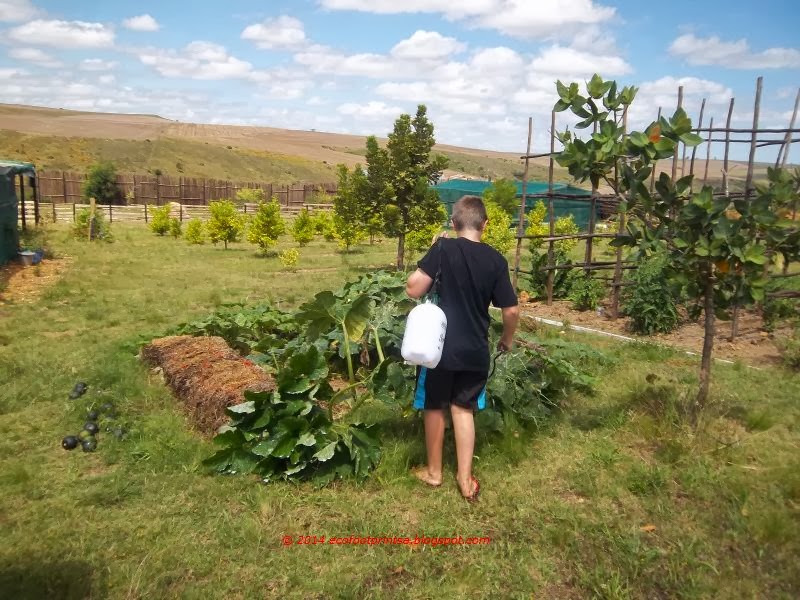
So then, after searching Google, I tried a 60% milk and 40% water mix.  Mike was more than happy to toddle round and apply the mixture.
Mike loved spraying the plants - and what a
great help he was :)
You can see some of the squash I harvested
on the left of the photo - the plant was removed
and burnt the same day.
But, that didn't work either.  So I ripped out the squash plants - I didn't want the leaf mould spreading to my pumpkins and butternuts.  Thinking about it, the squash plants have always developed leaf mould - so, note to self, don't plant squash in future...!

But, then, the strawbales containing a pumpkin plant each developed an illness - or predator.  I came outside one morning to water them, and discovered great wacking holes in the bales. Neither RMan nor I could figure out what or who had caused that.
What on earth is causing this collapse of the
strawbales?  Hares, small deer, Scallywag...?
Until yesterday that is.  I caught the culprits in action...
Can you see the culprits?  One has it's tail up
in the air, and the other is busy muching on
something...
The ducks which adopted us back in September last year - they l-o-v-e digging in the bales... Grrrrrrrrrr!

But, I have to confess, watering the bales was always a problem - the water just seemed to slide off and / or leak out.  The plants always looked like they were thirsty - even if I had watered them an hour before.

So, alpaca dung filled tyres and the ground it will be for the pumpkins and butternut I plant in future.